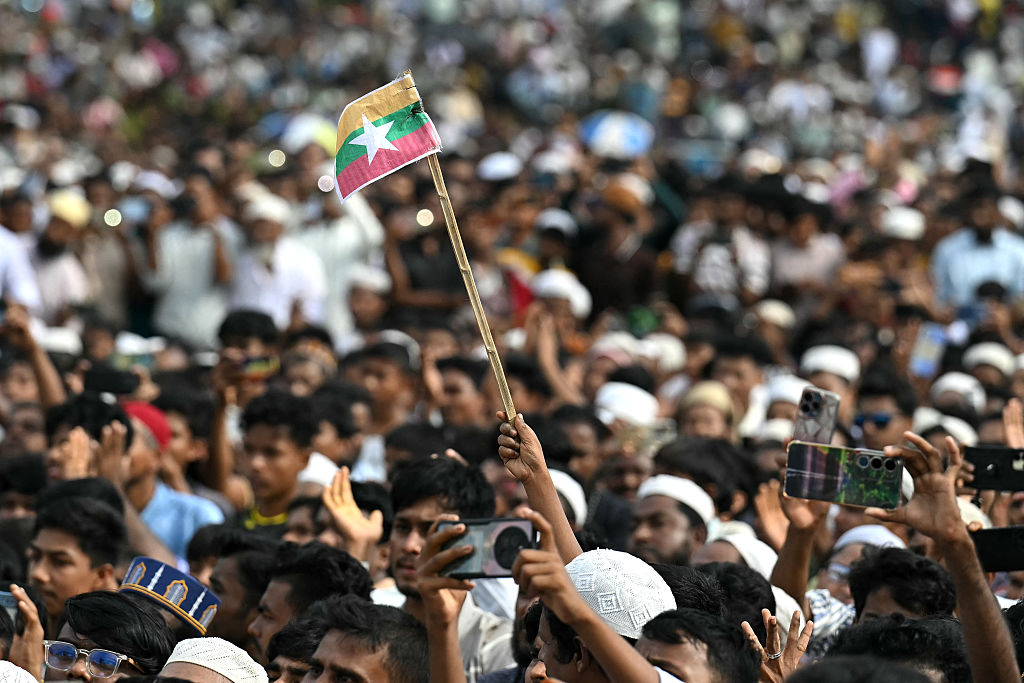
The International Court of Justice (ICJ) has determined that Myanmar committed genocide against its Rohingya Muslim minority, marking the first time in the court’s history that a state has been found responsible for such a crime. The landmark verdict, issued Thursday, addresses a military campaign in 2017 during which Myanmar forces killed at least 10,000 people, including up to 2,109 children under five, and forced over 700,000 others to flee northern Rakhine State. More than a million Rohingya remain displaced today, primarily in refugee camps in Cox’s Bazar, Bangladesh.
Myanmar’s military-backed government rejected the decision, with a spokesperson for President Min Aung Hlaing calling the ruling “unfair” and noting that six of the 15 judges dissented. Khine Khine Soe, the spokesperson, did not clarify whether Myanmar would comply with the court’s orders. Conversely, the National Unity Government, a parallel administration formed after the 2021 military coup, stated on Thursday that it respects the judgment. Sayed Ullah, a Rohingya community leader in a Bangladeshi refugee camp, said the ruling provides “public acknowledgment… that what happened to them was genocide,” validating the Rohingya as a distinct ethnic group despite Myanmar’s historical denial.
The court ordered Myanmar’s government to ensure the safe, voluntary return of Rohingya refugees and to prosecute individuals suspected of committing genocide. Myanmar has two years to report on restitution efforts; if unable to do so, it must pay reparations, with amounts to be determined later. Legal experts note that enforcement remains a challenge, as there is no direct mechanism to compel compliance. The Gambia, which brought the case, could petition the U.N. Security Council, though China’s friendly stance toward Myanmar may hinder action. Meanwhile, the United Kingdom expelled Myanmar’s defense attaché, and the Association of Southeast Asian Nations (ASEAN) was urged to support implementation. The ruling may also bolster individual criminal accountability, including an International Criminal Court arrest warrant sought in 2024 for Min Aung Hlaing.
The verdict has significant implications for South Africa’s pending case alleging that Israel committed genocide in Gaza. Both cases rely on the argument that a broader “pattern of conduct”—including hate speech, discriminatory laws, destruction of property, and attacks on children—demonstrates genocidal intent. The ICJ ruled that Myanmar’s targeting of children was inconsistent with a counterinsurgency operation. Similarly, South Africa argues that Israel’s military campaign, which has killed over 74,000 Palestinians according to the Gaza Health Ministry, reflects such intent. While Israel maintains its actions were acts of self-defense following the October 7, 2023, Hamas attack, the Myanmar ruling provides legal ammunition for arguments that civilian casualties, particularly among children, indicate a violation of the 1948 Genocide Convention. However, international law experts caution that without a formal doctrine of binding precedent, the Myanmar decision does not automatically determine the outcome of the Gaza case.

Does this mean reparations will actually happen? I hope the money reaches the refugee camps in Bangladesh.
The UK expelling the attaché is a small step, but it definitely sends a message to ASEAN members.
China blocking action at the Security Council makes this whole process feel like a farce sometimes.
The dissenting judges bother me. How can you disagree that killing thousands of children was genocide?
Two years for reports? That timeline feels too generous considering the massive humanitarian crisis on the ground.
Finally some recognition for the Rohingya. They have suffered for decades and been denied their identity.
Myanmar rejecting the ruling shows how weak international courts really are. Who actually forces them to listen?
The precedent for South Africa is huge. Lawyers are definitely watching this closely for the Gaza case.