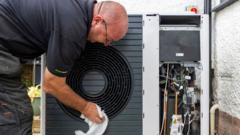
Developers in England are now required to install heat pumps and solar panels in all new housing projects, a regulatory change announced in March aimed at helping the UK meet its net zero climate targets. While this requirement is estimated to add approximately £10,000 to the price of new homes, officials note that owners are likely to see long-term savings on their energy bills.
The push for decarbonization comes amid broader government efforts, including the £15bn Warm Homes Plan introduced in January to assist households with green technology adoption. However, a recent autumn budget reduced this program by £1bn to fund defense spending. Heating currently accounts for roughly one-fifth of the UK’s planet-warming emissions, making the transition from gas and oil boilers to electric heat pumps a priority for the government.
Heat pumps operate by using electricity to absorb and amplify heat from the air, ground, or water. Air source models, the most common type, use refrigerants to extract heat from outdoor air, which is then compressed to raise the temperature for distribution throughout the home. These systems consist of an external unit and an indoor unit similar in size to a standard gas boiler, along with a hot water cylinder. Ground source alternatives are more efficient but require significant excavation and carry higher installation costs.
Financial support for the transition includes the Boiler Upgrade Scheme, which offers a £7,500 grant for air or ground source heat pumps in England and Wales. On average, homeowners still face out-of-pocket costs of around £5,000, a figure the UK’s spending watchdog has identified as potentially prohibitive for many households. The grant is available for existing homes and non-domestic buildings that hold a valid Energy Performance Certificate issued within the last decade, with recent updates removing the requirement for pre-existing loft or cavity wall insulation, thereby saving applicants up to £2,500 in upfront costs.
Additional funding streams, such as £5bn allocated to the Warm Homes Local Grant and Social Housing Fund, target low-income households and social housing providers. Furthermore, residents in Scotland and Northern Ireland can access separate national schemes, while UK households may also apply for low or no-interest loans ranging from £7,500 to £35,000 under the Warm Homes Loan Scheme.
Policy changes have also eased installation restrictions. The requirement for planning permission when placing a heat pump within one meter of a neighboring property has been abolished to encourage uptake. Modern units are designed to operate below 42 decibels, comparable to the noise level of a refrigerator. While the government maintains that heat pump installations will benefit from a 0% VAT rate currently, this tax advantage is scheduled to revert to 5% in April 2027, and funding for the Boiler Upgrade Scheme is set to remain at £400m in 2027-28 before inflation adjustments.
According to the Climate Change Committee, heat pumps could become cheaper to run than gas boilers, particularly as electricity prices decouple from gas markets due to renewable energy expansion. The innovation charity Nesta estimates that homes combining heat pumps with solar panels could reduce annual energy bills by nearly £1,000. Despite these incentives, heat pumps are found in less than 2% of UK homes, with installation rates lagging behind those in major European countries like France, Germany, and Italy, though adoption has grown in recent years.



Still five thousand out of pocket is too much for most people, even with the government grants.
Getting solar and a heat pump together could save a thousand pounds a year for sure.
The noise level is similar to a fridge. My neighbors were skeptical, but they are quiet.
Cutting the Warm Homes Plan by a billion really worries me. Who pays for that defense money?
Ground source is better but the digging is a nightmare. Air source is much more practical for me.
The VAT increase in 2027 feels like a trap. Everyone should install them before April.
France is miles ahead of us on adoption, so why are we still only at two percent?
Removing the insulation requirement saves money, but does that mean the house stays colder in winter?
I switched to a heat pump last year and the heating costs have genuinely dropped by a third.
The extra ten grand on new homes is a tough ask for buyers already struggling with rising costs.