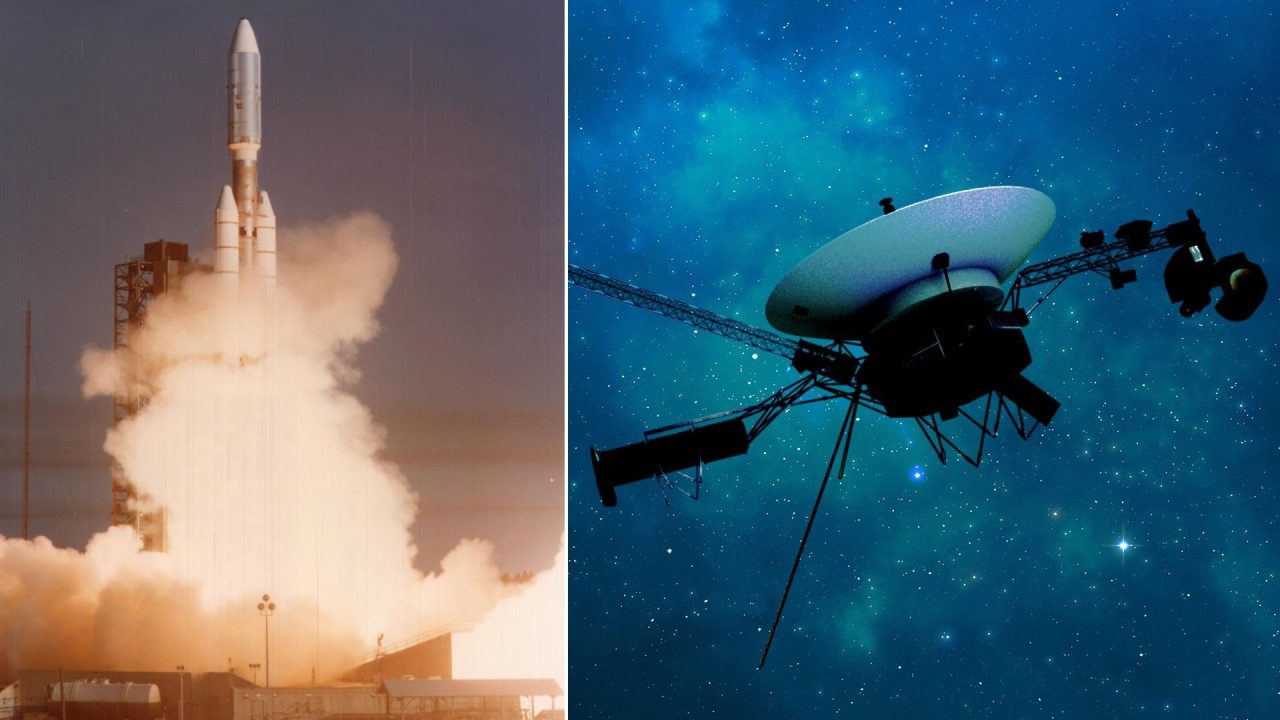
On November 18, NASA’s Voyager 1 probe will reach a milestone distance of one light-day from Earth, meaning it will take a full 24 hours for a signal to travel from the spacecraft to the planet. At this point, Voyager 1 will be approximately 16,094,799,096 miles (25,902,068,356 kilometers) away. In contrast, its twin, Voyager 2, will not achieve this specific distance until approximately 2035. Although the two spacecraft launched only about two weeks apart in 1977, with Voyager 2 actually departing first, Voyager 1 has significantly outpaced its sibling in the race to the outer solar system.
The disparity in distance is primarily the result of distinct strategic decisions made during the missions’ early phases to optimize for both speed and scientific data collection. NASA selected a faster trajectory for Voyager 1 to reach Jupiter more quickly, while Voyager 2 was routed to conduct a comprehensive tour of all four giant outer planets: Jupiter, Saturn, Uranus, and Neptune. Voyager 1, after visiting Jupiter and Saturn, utilized a maneuver at Saturn to investigate the rings and the moon Titan before exiting the solar system’s plane. This approach allowed Voyager 1 to accelerate to a current speed of 3.5 astronomical units per year, whereas Voyager 2 moves at a slower pace of 3.1 astronomical units per year.
The gravitational slingshots used by both spacecraft played a crucial role in their acceleration. When Voyager 1 flew by Jupiter in March 1979, it gained approximately 10 kilometers per second in speed. Voyager 2 did not reach Jupiter until July of the same year, gaining similar momentum. While these gravity assists provided significant speed boosts for Voyager 1, Voyager 2’s later encounter with Neptune in 1989 resulted in a loss of speed. To explore the moon Triton, Voyager 2 executed a maneuver that took it over Neptune’s north pole and out of the solar system’s equatorial plane, sacrificing velocity for unique scientific data.
Despite these differences, both probes have successfully entered interstellar space, with Voyager 1 crossing the heliopause in 2012 and Voyager 2 following in 2018. NASA’s Jet Propulsion Laboratory is now focused on extending the operational life of both craft, which are expected to function into the 2030s if their nuclear power sources endure. Engineers have recently implemented power redistribution procedures to maximize the scientific return from these historic missions as they continue their long journey through the cosmos.


Hearing about the specific speeds in astronomical units makes their journey feel incredibly vast and distant.
Is the difference in their trajectories permanent, or will Voyager 2 eventually catch up slightly?
The power redistribution efforts are crucial. We really need to squeeze every bit of science out of them.
NASA did smart work prioritizing speed for Voyager 1. We learned a lot from that choice.
It feels poetic that they launched two weeks apart but have such different destinies now.
Can we expect the probes to still send data reliably until 2035 without major battery failures?
The gravity assist details explain so much. Space physics is just fascinating in these small ways.
I always assumed the probes launched at the same time and traveled on identical paths.
Voyager 2 sacrificed speed for science. Those Uranus and Neptune flybys were truly worth it.
It is wild to think a light-day signal takes twenty-four hours just to reach us.