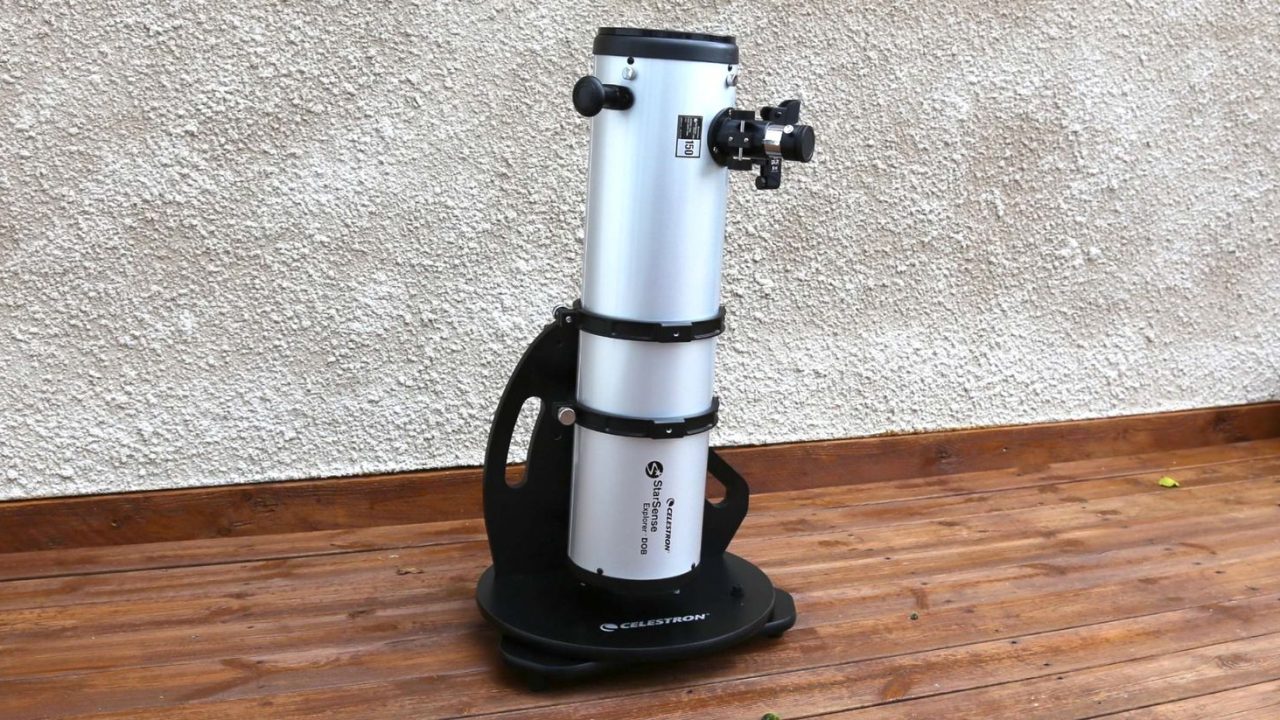
The Celestron StarSense Explorer 150mm Tabletop Dobsonian Telescope provides a compelling entry point for new stargazers, combining intuitive smartphone navigation with high-quality optics. Priced at $599 RRP (£379), the instrument features a 150mm (5.9-inch) parabolic primary mirror with a 750mm focal length and f/5 focal ratio, delivering sharp wide-field views suitable for both planetary and deep-sky observation.
The standout feature is the StarSense Explorer system, which uses a smartphone docked on the telescope to guide users to celestial objects. Unlike automated GoTo telescopes, this system requires users to physically move the scope while on-screen arrows and a bullseye indicator confirm their progress. This manual approach helps beginners learn the night sky while ensuring accurate targeting. In testing, the system successfully located Saturn, the Pleiades, the Andromeda Galaxy, and the Double Cluster in Perseus without difficulty.
Optical performance is impressive, with the 5.9-inch aperture allowing clear views of Saturn’s rings and Titan at 75x magnification using the supplied 10mm Kellner eyepiece. The telescope also excels at wide-field views of star clusters like the Pleiades. However, the supplied 25mm and 10mm eyepieces are considered entry-level, and the basic 1.25-inch rack-and-pinion focuser exhibited noticeable wobble and vibration during use.
The tabletop design, while compact, proved less convenient than expected. Weighing 25 lbs (11.33 kg), the telescope is heavy and awkward to lift onto a sturdy surface, which is necessary to prevent vibrations. Furthermore, assembly was more laborious than typical for a beginner-oriented scope, taking approximately 90 minutes and causing physical strain during the installation of base screws. While the Dobsonian mount itself offers smooth movement and good balance, the need to find a table of the correct size and stability adds a layer of complexity that larger, ground-based models do not have.
For beginners interested in visual astronomy, the StarSense Explorer 150mm is a strong recommendation due to its excellent optics and user-friendly guidance. Those prioritizing planet observation might prefer a refractor, while users seeking more light-gathering power may find the 8-inch StarSense Explorer Dobsonian a better long-term investment. The 150mm model remains a solid choice for those who value the hands-on experience of manually navigating the sky with the aid of modern technology.



The Kellner eyepieces are just okay. Plan to upgrade them soon if you want the best views.
Finding a sturdy enough table in the backyard is the hidden boss fight of this purchase.
I love that you have to move the scope yourself. It teaches you the sky better than auto-go-to.
For under four hundred pounds, you can’t really argue with the optics. It is a solid starter for most people.
Does the wobble really affect viewing Saturn? I worry about shaky images even with the manual navigation system.
Ninety minutes of assembly? That sounds brutal. I prefer my scopes to be out of the box and ready to go.
I bought this for my kid. The phone app is magic, but the heavy base is a pain to move around.