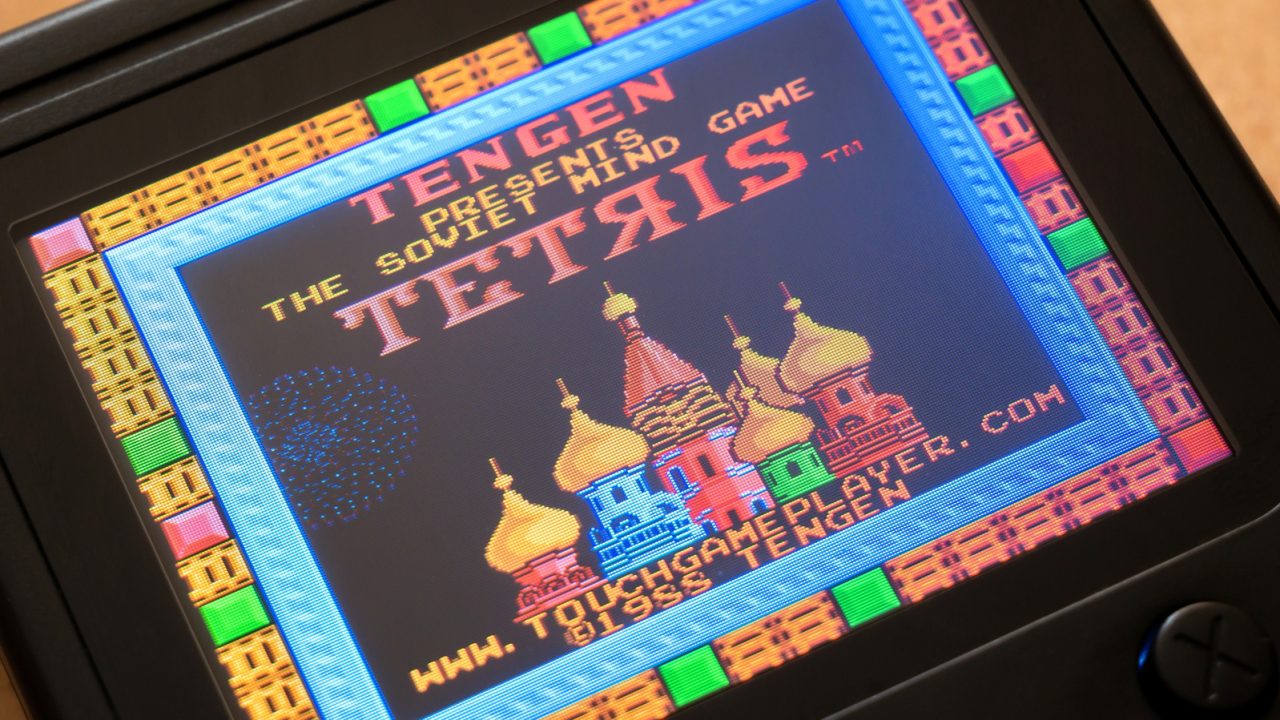
Tetris has established itself as the most re-released video game in history, with over 200 official versions released across various platforms. While titles like Skyrim or Super Mario Bros. have seen numerous re-editions, the iconic puzzle game dwarfs them in terms of distribution, appearing on nearly every device imaginable alongside countless bootleg ports.
The game’s origins trace back to 1984-1985 in the Soviet Union, when programmer Alexey Pajitnov developed the title for the Elektronika 60 computer. Initially using text-based graphics due to hardware limitations, Pajitnov and colleagues soon ported the game to the IBM PC. It spread rapidly through regional distribution and was later adapted for popular systems including the Commodore 64, Amiga, and Macintosh.
A pivotal moment occurred in 1989 with the release of Tetris on the Nintendo Game Boy. Following a complex licensing process and legal battles, Nintendo secured the rights to bundle the game with the handheld in most markets. This version, which featured the iconic “Theme A” music, became the best-selling non-mobile iteration with over 35 million copies sold.
In 1996, Pajitnov co-founded The Tetris Company with Henk Rogers to manage branding and licensing. Since then, the game has adhered to a set of internal rules known as the Tetris Guideline, ensuring consistency across official releases. The title’s enduring popularity has even influenced other puzzle games; for example, the SNES game Tetris Attack was originally titled Panel de Pon in Japan before Nintendo licensed the Tetris name for international release.
Notable iterations have introduced distinct features over the decades. The 1989 NES version was unique for its “kill screen,” which caused the game to end at a high speed, fostering competitive play around maximizing scores before the limit. In contrast, Tetris DX for the Game Boy Color (1998) introduced Sprint mode, while The New Tetris on the Nintendo 64 (1999) allowed for four-player competition and the piece-holding feature. Tetris DS (2006) brought official online play and themed modes based on other Nintendo franchises.
Modern entries continue to expand the franchise’s reach. Puyo Puyo Tetris (2017) merged two puzzle styles, Tetris Effect (2018) offered an immersive VR and standard visual journey, and Tetris 99 (2019) adapted the battle royale format to the genre. Most recently, 2024’s Tetris Forever served as a retrospective interactive museum celebrating the series’ 40-year legacy.



My kids think it’s new because of the mobile app. Funny how generational divides manifest in gaming habits.
I remember the legal battles over the licensing. Wild story. The company was always very protective of the brand.
The NES version had that weird kill screen that always frustrated me. Glad they fixed that issue years later.
Skeptic alert. Why are there so many versions? Did the gameplay actually change, or is it just rebranding tricks?
Is it still just moving blocks? Or did they finally add some actual story elements to it this time?
My dad played it on the Game Boy. I play it on my phone. It really is timeless stuff.
Can’t believe I’m saying this, but I actually enjoyed that one. The nostalgia factor is truly off the charts.