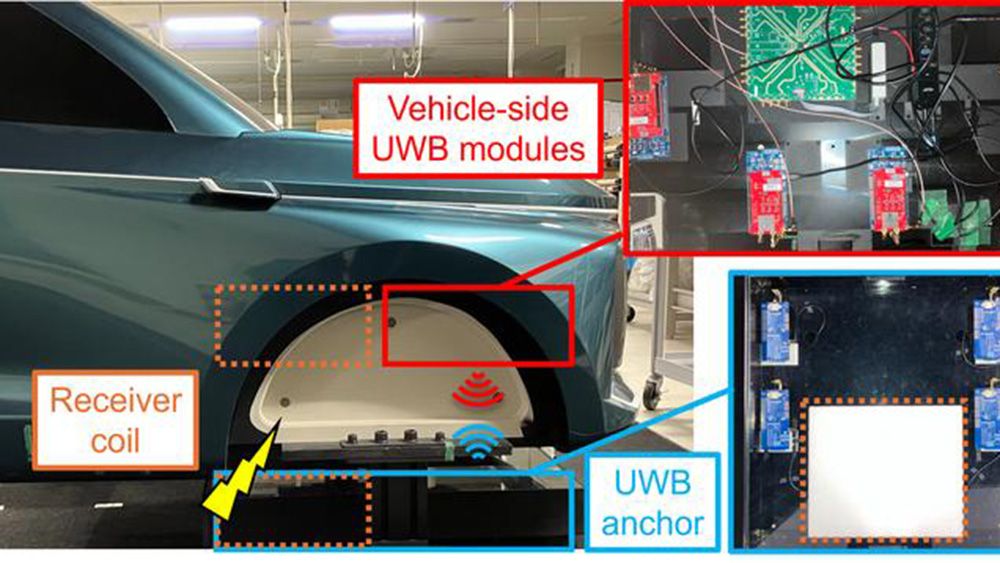
Researchers at the University of Osaka in Japan have introduced a technology that aims to make wireless electric vehicle (EV) charging more precise and efficient, enabling cars to recharge simply by parking.
While wireless charging technology, similar to that used in smartphones, is emerging in the EV market, it faces significant challenges due to misalignment between the transmitter coil in the ground and the receiver coil under the vehicle. Even minor positioning errors can drastically reduce charging speed and battery efficiency. Current alignment methods relying on magnetic sensors or cameras have limitations; magnetic sensors require close proximity, while camera systems are often hampered by poor lighting, rain, or dirt.
The new system utilizes four ultra-wideband (UWB) radio devices mounted around the vehicle’s charging coil, which communicate with four antennas located around the ground charging pad. By measuring the time it takes for radio waves to travel between these devices and detecting subtle differences in signal arrival times, the system can determine the exact distance and angle of the vehicle’s coil relative to the charger. This technology mirrors that used in digital car keys, which use short radio pulses to detect proximity for keyless unlocking.
In laboratory tests using a scaled-down vehicle model, the system demonstrated high accuracy, pinpointing the coil’s position within 0.09 inches (2.32 millimeters) and its orientation within 0.25 degrees. The researchers noted that correcting for signal distortions reduced positioning errors by approximately fivefold. The technology is particularly promising for autonomous “robotaxis,” which require efficient recharging capabilities without human assistance to park and align the vehicle.
The findings were published on August 26 in the IEEE Open Journal of Vehicular Technology. Ryotaro Hada, a master’s student at the University of Osaka’s Graduate School of Information Science and Technology and the study’s first author, stated the team hopes this research will lead to a future where EV charging is as simple as placing a smartphone on a wireless charger. However, the researchers emphasized that the system still requires testing in outdoor environments, on full-size vehicles, and under real-world charging conditions.
This will change the robotaxi business model completely. No more drivers wasting time trying to align the charging pad.
It’s fascinating they can get sub-centimeter accuracy with radio waves. Hope real-world rain and mud don’t mess up the signals.