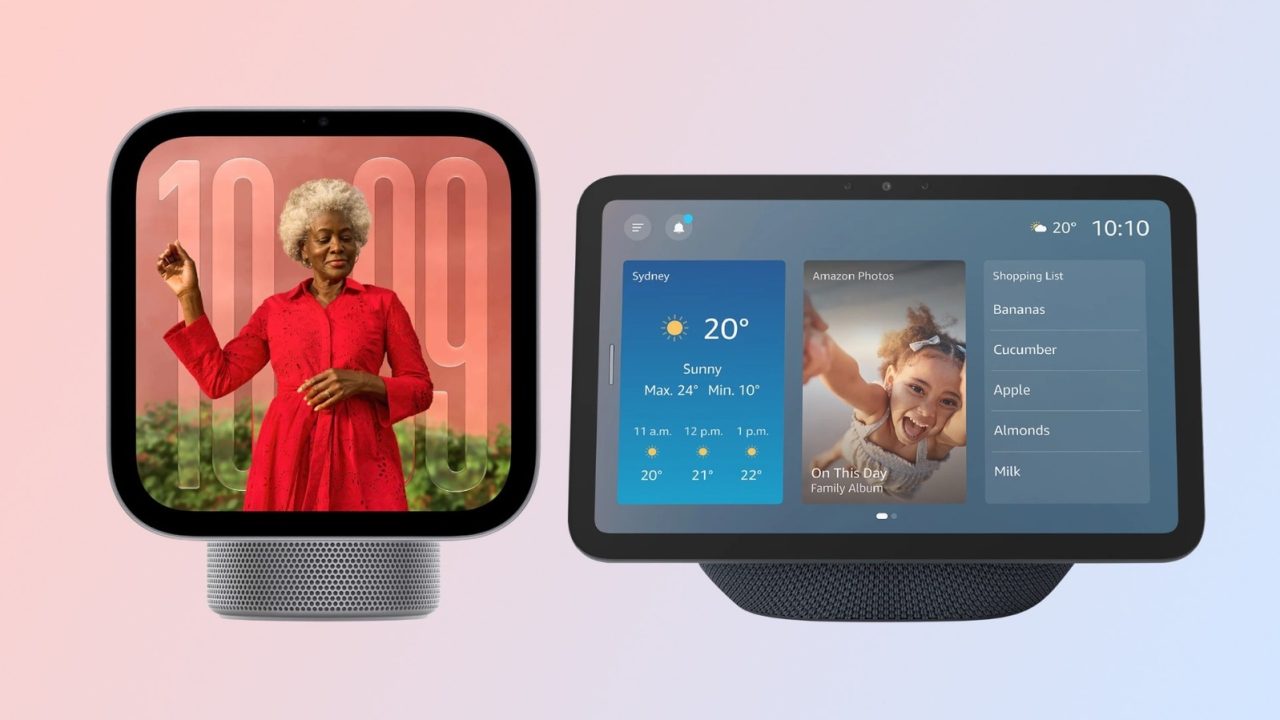
Apple’s recently announced HomeView smart display and Amazon’s established Echo Show series both bring AI assistants into the home, yet they operate on fundamentally different principles. While Amazon offers a wide variety of Echo Show models ranging from a 5.5-inch entry-level device costing $99 to a premium 21-inch screen priced at $499, Apple currently provides the HomeView in a single format featuring a 7-inch square screen.
The design differences extend to screen aspect ratios, with Amazon’s widescreen displays better suited for viewing 16:9 video content, whereas the square HomeView screen may be less ideal for that purpose. In terms of processing power, the HomeView utilizes the A18 chip, the same processor found in the iPhone 16, making it likely the most powerful smart display on the market. Amazon, by contrast, uses custom chips for its Echo devices that prioritize functionality over raw performance.
Camera capabilities also differ significantly. The HomeView includes a 12-megapixel camera primarily dedicated to FaceTime calls, a mirror feature, and facial recognition. The Echo Show 8, equipped with a 13-megapixel camera, offers additional versatility, allowing users to take selfies or use the device as a live-view security camera for home monitoring. Audio specifications are comparable between the two, with both featuring two full-range drivers and a woofer, although the HomeView adds two passive radiators for enhanced low-end sound.
The most significant distinction lies in how the devices interface with users and require connectivity. The Echo Show functions as a standalone device linked to an Amazon account, capable of running directly on the network. In contrast, the HomeView is strictly dependent on Apple’s ecosystem, requiring an iPhone or iPad for initial setup and ongoing functionality. While the Echo Show allows users to access Alexa+ features through a Prime membership without their phone, the HomeView’s Siri AI capabilities for personal requests are limited to scenarios where a recently unlocked iPhone 15 Pro or newer is paired and nearby.
Software ecosystems further diverge. Amazon relies on Alexa Skills, which are extensions that can be added to the assistant, including integrations with third-party services like Apple Music. The HomeView, however, lacks a traditional App Store and instead mirrors CarPlay apps installed on the user’s iPhone, severely restricting the available app library due to the limited number of CarPlay-compatible applications. Both devices support multiple user profiles verified by voice and face; while Amazon allows users to manually switch profiles by asking Alexa, the HomeView attempts to switch automatically, a feature that some early reviews suggest does not always work reliably.
Ultimately, these two products cater to different consumer bases. Amazon markets the Echo Show as a standalone product accessible to a broad audience, while the HomeView is positioned as an accessory specifically for Apple loyalists who already rely on the company’s core apps and hardware.

I prefer the Echo for home security, but the HomeView chip sounds incredibly fast for just making calls.
The dependency on a nearby iPhone for basic Siri features feels like a massive inconvenience compared to the standalone Echo.