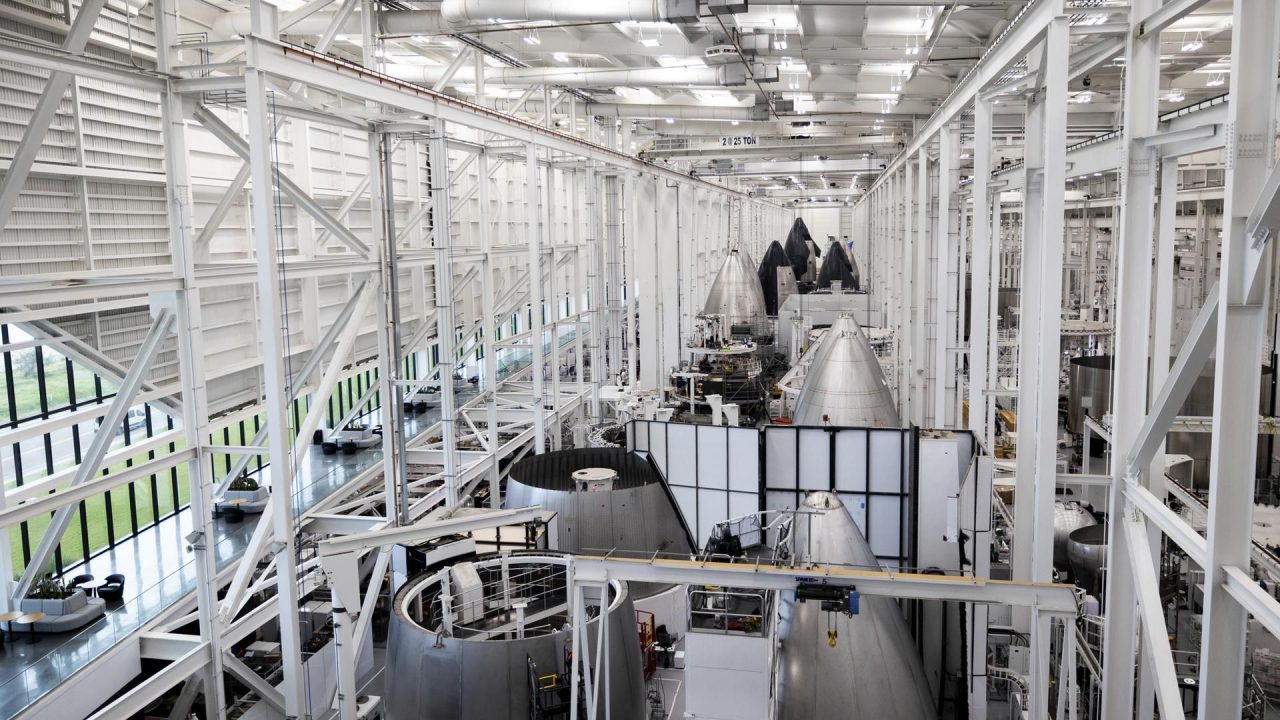
On November 13, ahead of the Starship Flight 15 mission, SpaceX granted media personnel a rare tour of its Starfactory facility at Starbase, Texas. The five-story, one-million-square-foot plant serves as the central hub for manufacturing and assembling both stages of the company’s massive Starship rocket. SpaceX officials describe the facility’s layout as resembling an automotive manufacturing plant rather than a traditional aerospace site, emphasizing a production model focused on efficiency and high-volume output.
Inside the facility, visitors observed the sheer scale of Starship components, including nose cones, cylindrical sections, and booster parts in various stages of manufacture. The inventory included hardware for vehicles up to Ship 51, with one prototype featuring window cutouts likely destined for NASA’s Artemis program. NASA has contracted SpaceX to develop a Starship variant capable of landing astronauts on the moon, with Artemis IV targeted for 2028. While Blue Origin is also competing for the lunar lander contract with its Blue Moon system, SpaceX is actively advancing its own prototype.
Production metrics indicate that SpaceX is currently completing one Starship upper stage every two weeks and one Super Heavy booster every four weeks. Most of the vehicles in production are intended to carry stacks of SpaceX’s upgraded Starlink Version 3 (V3) satellites. The Starlink network in low Earth orbit now comprises more than 11,000 spacecraft. Recent test flights have added data capacity equivalent to ten Falcon 9 launches per mission, and the company aims to increase launch cadence to approximately one Starship flight per week beginning in 2027.
The manufacturing process mirrors the automotive industry, utilizing in-house designed tools to refine production and eliminate bottlenecks. SpaceX maintains a workforce of technicians on the floor rather than relying solely on automation, as the Starship design continues to evolve. A tour guide compared the company’s consistency goals to the precision of Lego bricks, which are manufactured to micro-millimeter accuracy.
Adjacent to the Starfactory are two Mega Bays, each capable of holding five or six assemblies, where rocket stages are integrated with engines. SpaceX is also constructing the Gigabay, a 700,000-square-foot facility that will accommodate up to 24 vehicles simultaneously, significantly expanding assembly capabilities. Although the Super Heavy booster from Flight 15 diverted to an offshore landing and exploded, the returned Ship 42 was successfully caught by the launch tower the following day, underscoring the rapid pace of development and testing at Starbase.



Eleven thousand Starlink satellites. I hope they eventually find a use for that much capacity.
The booster exploding offshore while the upper stage got caught is the perfect summary of this era.
Surprised to see window cutouts. That likely means NASA’s lunar lander is actually coming soon.
Love that they still use human technicians. Fully automated lines struggle with evolving designs like Starship.
The Lego comparison is clever but risky. Aerospace needs zero defects, not just consistent parts.
Two weeks per stage sounds insane. Is that actually realistic for complex hardware, or just marketing hype?