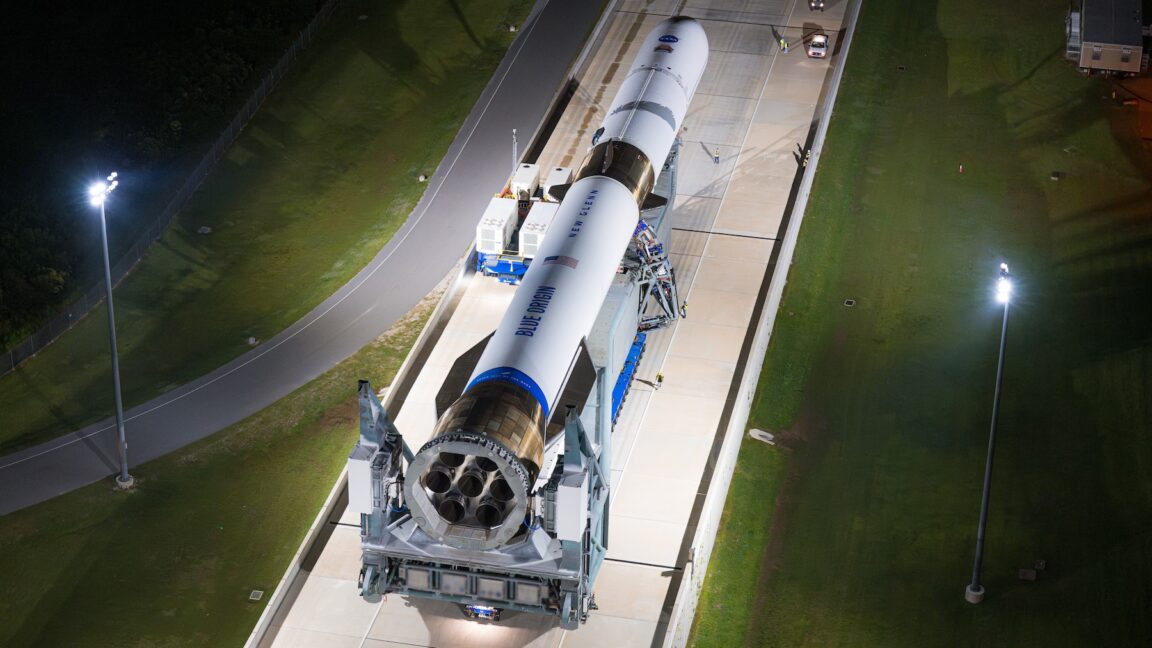
Blue Origin announced Thursday that its New Glenn rocket will be responsible for launching data center satellites for Google in 2029. This mission is part of Google’s Project Suncatcher program, a long-term initiative focused on expanding AI infrastructure into space.
Google revealed approximately a year ago that it was developing scalable orbiting data centers, describing the effort as one of its research “moonshots.” The planned launch will deploy satellites equipped with computing capacity comparable to a standard data center rack. These units will be placed into Sun-synchronous orbit to allow them to harness nearly continuous solar energy.
“Project Suncatcher is a long-term moonshot to scale AI infrastructure in space by tapping into the abundant solar power in orbit,” Travis Beals, senior director of Project Suncatcher at Google, stated in a news release. He added that the dedicated launch with Blue Origin marks a crucial milestone on the company’s roadmap as it seeks to expand the boundaries of future compute capabilities.



This is the future of computing. Earth data centers are too energy-intensive, so space is the logical next step.
The environmental cost of launching all these heavy rockets is still a major concern, no matter where the servers end up.
I just want to know how much bandwidth we will have to download from orbit. Will it be slow?
Google calling it a moonshot tells you how far away this is from actual product availability right now.
If it works, renting space compute will be way more expensive than terrestrial options for regular businesses.
Jeff Bezos is doing this to counter SpaceX. It is good for competition in the launch market.
What about the heat dissipation? How do you cool a server rack in the vacuum of space?
2029 feels optimistic. New Glenn has not flown successfully yet, so I am skeptical about the timeline.
Putting data centers in orbit seems insane until you realize solar power never stops. Wild concept.
Finally space tech for something practical other than tourism. I hope they solve the debris cleanup issue first.