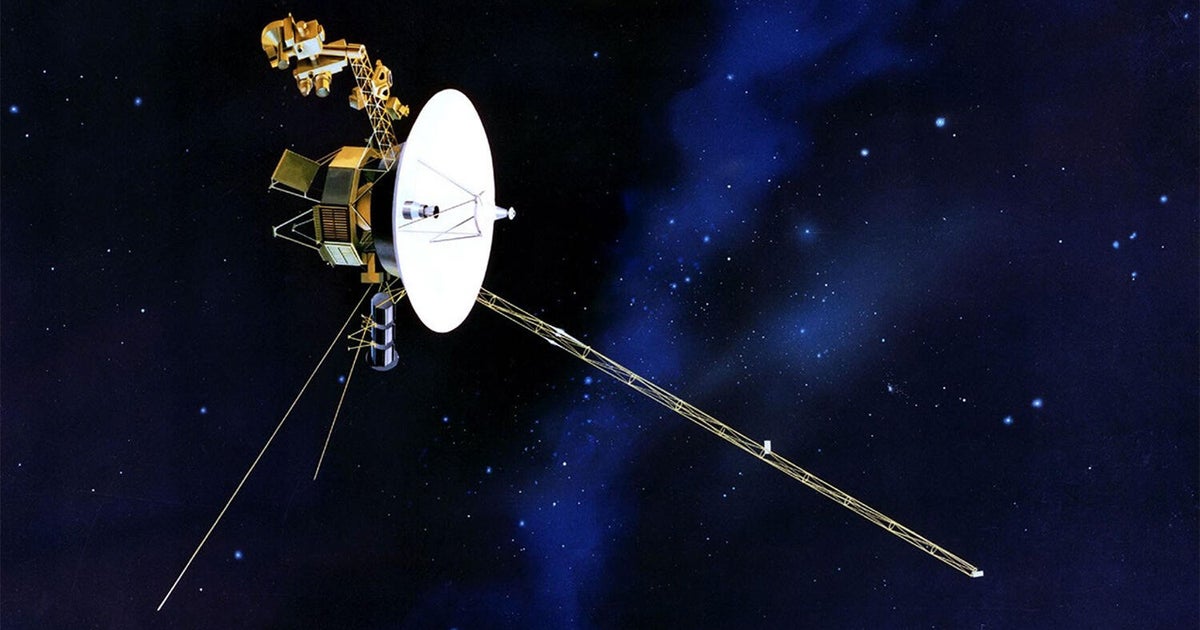
NASA’s Voyager 1 probe reached a historic milestone early Wednesday by traveling one light-day from Earth, a distance exceeding 16 billion miles. This achievement marks the farthest any human-made artifact has ever ventured from our planet. Launched in 1977, the spacecraft was originally designed to provide close-up views of Jupiter and Saturn and their moons.
The probe is currently moving through interstellar space at nearly 38,000 miles per hour. At this distance, radio signals, which travel at 186,000 miles per second, require 24 hours to reach flight controllers at NASA’s Jet Propulsion Laboratory (JPL). Consequently, the 13-member mission team must wait until Thursday to confirm the milestone with the first post-light-day signal. Voyager 2, launched on a different trajectory, also entered interstellar space in 2018 and continues to transmit data on magnetic fields and plasma waves.
Kareem Badaruddin, the Voyager Interstellar Mission Manager, described the achievement as one of the great things humans have ever done. While the spacecraft’s power sources are decaying, engineers hope to keep the data flowing for several more years. Voyager 1, now operating on just over 210 watts of power, can run two of its original ten instruments. Its sister ship, Voyager 2, has slightly more power available to operate three instruments.
Even after their nuclear power is exhausted, the Voyagers are expected to remain intact and continue drifting for over a billion years, likely outlasting human civilization. Both spacecraft carry gold phonograph records encoding sounds, images, and greetings from Earth, serving as a message in a bottle for any potential extraterrestrial discoverers. The signal sent back to Earth is incredibly faint, requiring giant antennas in the Deep Space Network to detect it. Suzanne Dodd, the Voyager project manager at JPL, noted that communication with the probes is slow, with responses to commands taking two days.
The Voyager program, approved in the early 1970s, capitalized on a rare planetary alignment to conduct a “Grand Tour” of the outer planets. Voyager 1 visited Jupiter in 1979 and Saturn in 1981, while Voyager 2 continued on to Uranus and Neptune in the late 1980s. In 1990, Voyager 1 captured the famous “Pale Blue Dot” image, which astronomer Carl Sagan used to reflect on humanity’s small place in the cosmos. Sagan emphasized the image as a reminder of our responsibility to treat one another kindly and cherish our home planet.



Knowing it will drift for a billion years makes you feel really small and temporary.
The delay in confirming the milestone is such a unique challenge for the mission team.
16 billion miles is too big a number for my brain to process. Mind blowing stuff.
Do we actually know anything is out there, or are we just sending random noise?
The engineering required to keep those instruments alive with such low power is genuinely impressive.
I hope alien civilizations find the gold records and think our music is incredible.
It is wild that these were launched in 1977. My grandparents would be amazed by this news.
Honestly, I wonder if it is even worth it anymore. The power is just dying out.
The Pale Blue Dot image still gives me chills. We need to treat each other better.
Wait, light signals take 24 hours? That means we are basically shouting into a void right now.