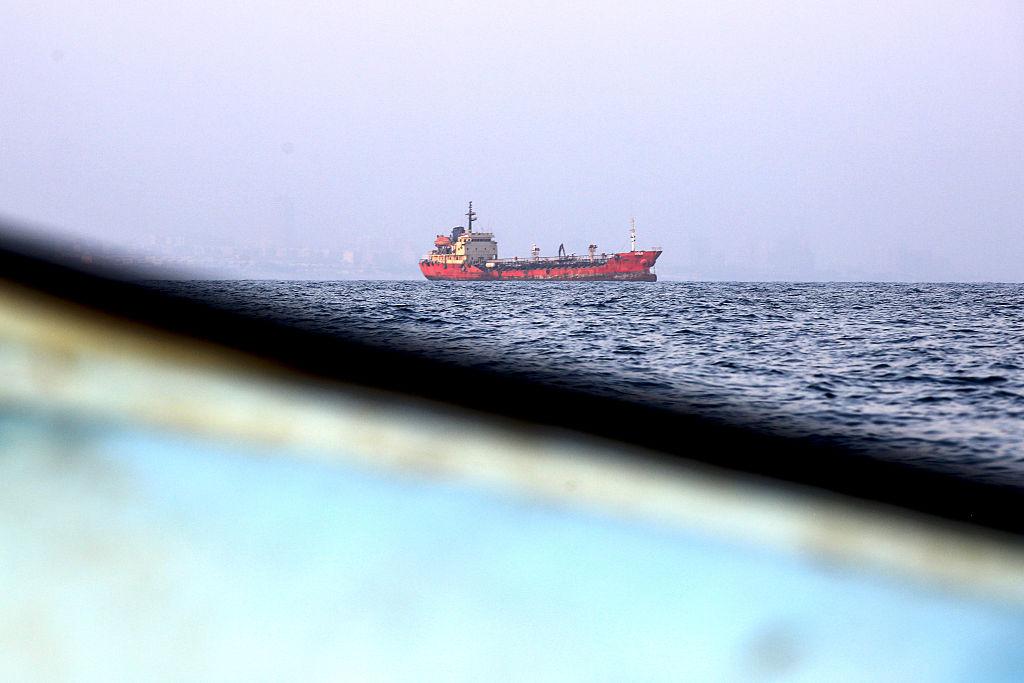
The United States and Iran engaged in a new cycle of military exchanges on Tuesday, marking the latest escalation in a conflict the Trump administration has promised to resolve following the U.S. midterm elections. American warplanes targeted a missile launch facility on Qeshm Island, a strategic location within the Strait of Hormuz. An unnamed official told CNN that the strikes were acts of “self-defense” in response to alleged aggression against American personnel and assets by Iran’s Islamic Revolutionary Guard Corps.
Prior to the U.S. retaliation, Iran attempted to strike American military targets in Bahrain, where the U.S. Navy’s Fifth Fleet is headquartered. U.S. Central Command reported that Iranian one-way attack drones were intercepted without causing damage to U.S. equipment or injuring American personnel. Additionally, Kuwait’s armed forces confirmed that air defenses were activated in response to drone attacks. Iran subsequently claimed responsibility for strikes on Kuwait’s Ali Al Salem Air Base, which houses U.S. troops.
Ahmad Nafisi, the deputy governor of Iran’s Hormozgan province, stated to state media that the attacks on Qeshm Island resulted in no damage to residential, commercial, or infrastructural areas. This latest flare-up mirrors recent skirmishes in the region, with Washington avoiding a resumption of major hostilities despite Qeshm Island becoming a significant flashpoint. According to a report by The Wall Street Journal, the U.S. conducted smaller-scale, unannounced strikes against Iran for several weeks to prevent attacks on commercial shipping in the strait.
Diplomatic efforts between Iran and mediators Oman and Qatar have failed to yield an imminent agreement. The U.S. maintains a blockade on Iranian ports to disrupt oil exports, and President Donald Trump has warned that full combat operations may continue if Tehran does not meet U.S. demands. On November 12, Trump posted on Truth Social that the need for a deal with Iran had passed, asserting that the U.S. controls the strait and holds hundreds of billions of dollars in Iranian assets.
Addressing the duration of the conflict, Vice President J.D. Vance told Fox News on Monday that the administration will not allow the situation to become a “forever war.” Vance emphasized that the conflict will conclude well before the administration’s departure from the White House in 2029. He attributed the Republican losses in the midterms to public frustration with the ongoing war and noted that while he was originally tasked with leading peace negotiations, President Trump reassigned him on November 12 to focus on domestic fraud investigations in Democratic-led jurisdictions.
Military analysts indicate that the U.S. continues to reinforce its presence in the region. The U.S.S. Theodore Roosevelt, a third American aircraft carrier, arrived in the Middle East on November 15. In Manila on Tuesday, President Trump responded to reports of Iranian plans to deploy a “dirty bomb” in Washington by stating that such escalation would result in a price “the likes of which no country has ever paid before.” President Trump is scheduled to hold a trilateral summit in China on Thursday with Chinese President Xi Jinping and Russian President Vladimir Putin, with the Iran war on the agenda.

Iran claiming no civilian damage sounds like standard state media spin. We rarely get verified reports from inside.
Did anyone actually read the trilateral summit details? China and Russia are supposed to discuss this Thursday?
Three carriers in the region means this isn’t just posturing. The Strait of Hormuz is extremely dangerous right now.
Vance focusing on domestic fraud instead of diplomacy seems like a massive red flag for voters.