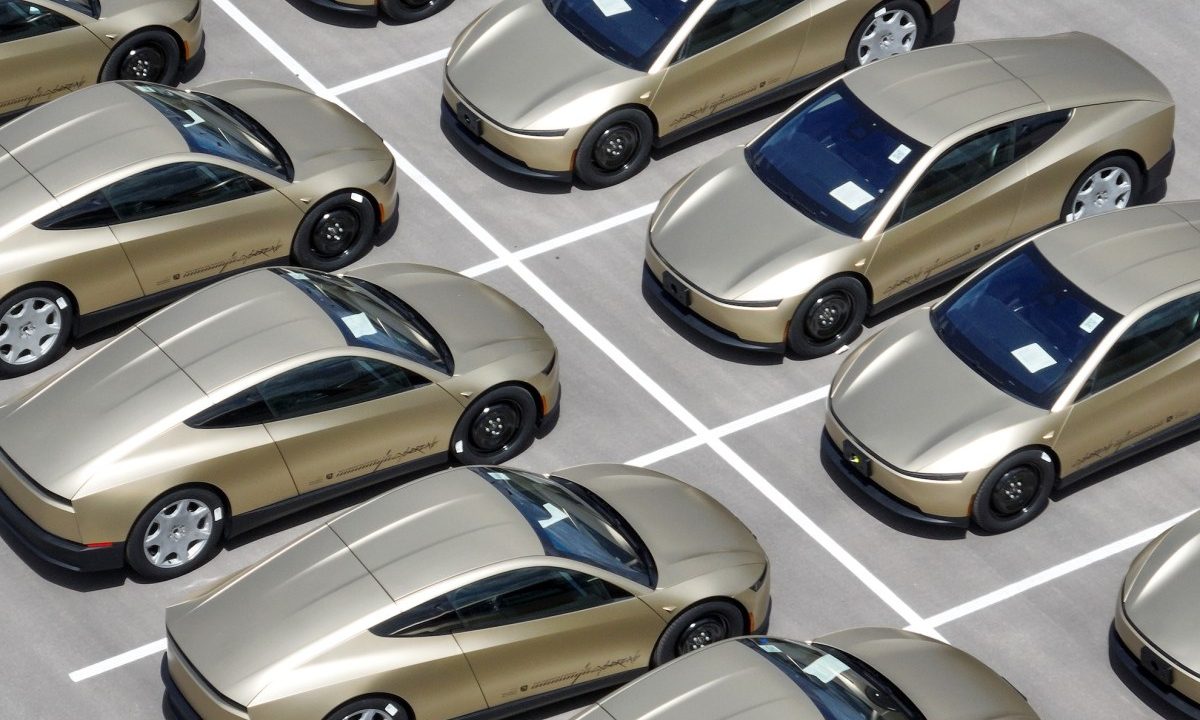
Tesla has announced a major investment of €3 billion ($3.3 billion) to expand its Berlin gigafactory, signaling its commitment to the mass production of its fully autonomous, two-seat Cybercab vehicles. André Thierig, Tesla’s senior director of manufacturing for the European site, confirmed that the new facility in Grünheide, located east of Berlin, will have an annual production capacity of up to 1 million vehicles. Construction on the expansion is scheduled to begin in the first half of 2027, with production of the Cybercab expected to commence in 2029.
The expansion represents a significant strategic shift for the company, which is increasingly positioning itself as an artificial intelligence and robotics firm rather than a traditional automaker. This move follows recent announcements that Tesla plans to cease production of the Cybertruck next year to free up manufacturing resources in Austin, Texas, for the Cybercab. The golden-hued vehicle, which lacks a steering wheel, pedals, and other standard driver controls, was first revealed in 2024 and began public operations in September 2026. Tesla has noted that its current fleet of autonomous vehicles in the United States has maintained a clean safety record over the past two months, with no major incidents reported, although federal regulators have launched an investigation into the company’s self-certification of the vehicle due to its deviation from standard federal safety requirements.
Tesla’s autonomous driving technology diverges from competitors like Waymo by relying exclusively on camera data to mimic human vision, rather than utilizing additional sensors such as lidar. While the company delivered over 486,000 vehicles in the third quarter, CEO Elon Musk remains focused on fully automated systems that do not require human supervision. Currently, approximately 573 Cybercabs are operating on roads in Austin, with plans to expand to Dallas, while the broader robotaxi fleet in Texas numbers around 1,307 vehicles, many of which are modified Model Ys. The decision to localize Cybercab production in Europe marks a pivotal moment in Tesla’s roadmap, extending its autonomous services beyond North America.



Dropping the Cybertruck to focus on the Cybercab shows where their priorities are. Smart move, honestly.
No steering wheel is terrifying. I hope they figure out the safety regulations before putting that on Berlin roads.
Building a million units by 2029 sounds optimistic. Tesla has missed production targets for years. Are they just dreaming again?