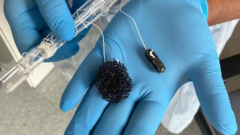
New draft guidelines for the National Health Service (NHS) in England recommend expanding the availability of rapid, non-invasive “sponge” tests for patients suffering from persistent indigestion. The initiative aims to screen for oesophageal cancer more efficiently than traditional hospital endoscopies, which currently face high demand and longer waiting times.
The testing procedure allows patients to swallow a small dissolving capsule attached to a thread in a GP surgery. Once the capsule reaches the stomach, it releases a tiny sponge that collects cells from the lining of the oesophagus. A doctor then gently pulls the sponge back out of the patient’s mouth for analysis. The entire process takes only minutes and is considered significantly less invasive than camera-based endoscopy checks.
These tests are particularly relevant for individuals with Barrett’s oesophagus, a condition linked to long-term acid reflux and heartburn that increases the risk of developing oesophageal cancer. Estimates suggest that between one and two adults in every 100 have this condition, where the cells lining the food pipe begin to change. While most cases do not progress to cancer, the volume of patients waiting for endoscopy screenings often means that checks are not performed as frequently as recommended.
Prof Jonathan Benger, chief executive of the National Institute for Health and Care Excellence (NICE), described the sponge tests as a “quick and less invasive” method to detect concerning cellular changes. He noted that these results help identify which patients require further, more complex tests and treatment. Prof Peter Johnson, national clinical director for cancer at NHS England, highlighted that thousands of patients have already benefited from pilot programs using this technology. He stated that widespread adoption would allow the NHS to free up resources for earlier cancer detection and reduce the burden of complicated endoscopy procedures.
Experts noted that while the sponge tests are highly efficient, they are not infallible. NICE guidelines emphasize that no diagnostic test, including endoscopy, can identify every single case of cancer. Therefore, patients who receive a negative result from the sponge test should continue to undergo long-term monitoring. Final recommendations on the rollout of these tests are expected to be finalized by NICE in the new year.
Reflux disease, which causes symptoms such as heartburn and a sour taste in the mouth, occurs when digestive juices seep up from the stomach into the oesophagus, often due to a weakened sphincter muscle. Risk factors include being overweight, smoking, and alcohol consumption.


I thought these were experimental only. Glad they are rolling out nationally soon.
Good news for reducing backlogs. Early detection is key, but remember it is not a complete cure-all.
A sponge in your throat? Feels gross honestly, but anything is better than sedation.
Does this work for everyone or just people with Barrett’s? My mom has chronic heartburn too.
Sounds good, but can it really catch everything? I had a false negative once and got sick later.
Finally! Endoscopy prep is such a nightmare. Swallowing a capsule seems way easier for busy people.