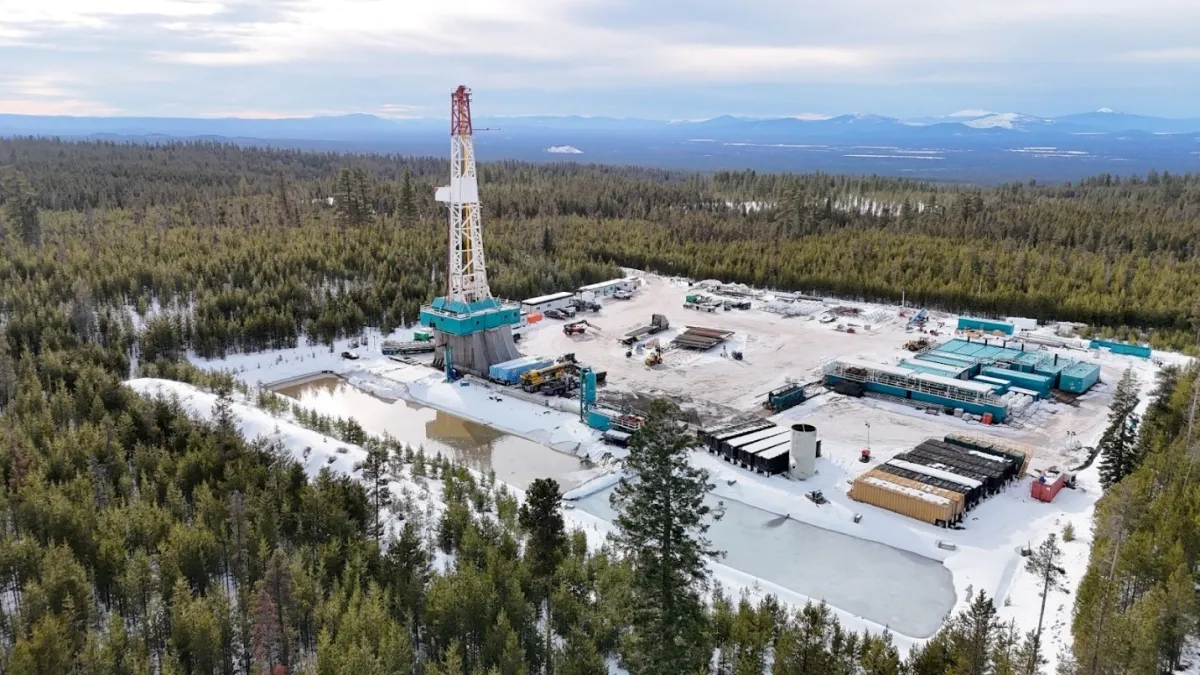
Mazama Energy has announced the development of a new technology called Carbon Chill, which addresses one of the primary obstacles in geothermal drilling: heat generation during rapid and deep drilling processes. By utilizing carbon dioxide to cool the drill bit and transport rock cuttings to the surface, the innovation aims to enable drilling at greater depths and faster rates, potentially making geothermal power more competitive on the electrical grid.
Sriram Vasantharajan, co-founder and CEO of Mazama Energy, stated that the technology increased the company’s rate of penetration by 20 percent compared to its previously high performance levels. Since drilling accounts for approximately 25 to 30 percent of the total cost of constructing a geothermal power plant, reducing the time required for this process could lead to significant cost reductions.
The startup has been working on these challenges for several years. In October 2025, Mazama drilled a well in Oregon that reached a temperature of 629 degrees Fahrenheit (331 degrees Celsius). According to Vasantharajan, a more recent well has surpassed 700 degrees Celsius. In September of this year, the Khosla-backed company raised $135 million in a funding round led by Centaurus Capital and Doerr Capital to support further drilling into super-hot rock formations.
Traditional geothermal drilling typically uses a mixture of water and other compounds, known as “mud,” to keep the drill bit cool and clear debris. However, this method is ineffective at the extreme temperatures found in super-hot rock layers, which exceed 752 degrees Fahrenheit (400 degrees Celsius). At these temperatures, standard electronics within the drill head often fail, and high-temperature-rated alternatives are prohibitively expensive.
In contrast, Mazama’s Carbon Chill system injects liquid carbon dioxide through the center of the drill string. As the CO2 moves deeper and is heated by the surrounding rock, it reaches a supercritical state. Before reaching the drill head, it is forced through a nozzle similar to a rocket engine component. The rapid expansion of the gas cools it down, effectively absorbing heat from the electronics and the bit.
“I look at carbon dioxide cooling as a binary. Without such technologies, I am, today, not able to drill these horizontal wells at super hot rock temperatures,” Vasantharajan said. Experts note that super-hot rock geothermal could be a promising method for improving well performance, as water in these conditions becomes supercritical, carrying five to ten times more energy than traditional geothermal water. This efficiency could reduce the number of wells required for a given energy output, lowering overall costs.
With the new capital, Mazama aims to complete a single well by next year capable of generating up to 15 megawatts of electricity. “What was just a dream or a quest, I can tell you with confidence is now a promise. We see a path towards this commercial super-hot rock geothermal,” Vasantharajan added. The potential impact is significant; a report from the National Laboratory of the Rockies estimates that geothermal energy could generate between 26.5 and 57 terawatts of electricity in the United States. Developing just 10 percent of the conservative estimate would more than double the country’s peak generating capacity, a capability that hyperscalers like Google and Meta are actively exploring for their future facility needs.



Dreams becoming promises is my favorite phrase. Keep pushing those Oregon boundaries, Mazama team.
Traditional mud systems fail at these temperatures. This innovation might be the missing piece for super-hot rock.
Twenty percent faster penetration is significant. Every second saved on the rig translates directly to lower capex.
Thirteen five million is decent, but you need billions to change the industry. Are they ready for that scale?
Seventy degrees Celsius hot rock sounds scary. I hope the electronics really can handle that expansion phase.
CO2 is everywhere. Turning a greenhouse gas into a cooling mechanism for drilling is a clever dual-use solution.
Love seeing local industry innovate. Deep geothermal could transform our state’s energy grid completely in a few years.
If this works, data centers might finally have a stable, clean power source. Huge implications for AI infrastructure.
Sounds great on paper, but can they scale this beyond one well? Costs usually explode during commercial rollout.
Supercritical CO2 engineering is wild. Using rocket nozzles to cool drill bits makes so much sense actually.