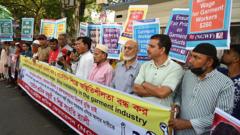
Production in Bangladesh’s garment sector has been significantly disrupted as workers launched strikes across major textile hubs, demanding an increase to the national minimum wage.
Nearly 150 manufacturing sites in Savar, Ashulia, and Gazipur were closed during the weekend unrest. Workers are pressing for a monthly minimum wage of 30,000 taka (approximately $36), arguing that the current statutory rate of 12,500 taka is insufficient to cover basic living costs in the face of inflation.
The demonstrations included a mass gathering on Sunday morning on the Dhaka-Tangail highway in Gazipur, where protesters blocked traffic for roughly an hour before police intervened to restore order. Local police officials confirmed that factories were shut down by officers following the walkouts, with reports indicating 13 facilities were closed on Saturday night and another 16 during the morning unrest.
Bangladesh’s garment industry is a major economic pillar, accounting for 10% of the country’s GDP and generating nearly $40 billion in annual exports. The sector employs approximately four million people and supplies major global retailers such as H&M, Primark, and Zara.
Industry bodies have warned that the prolonged unrest may have knock-on effects for international buyers. Under Bangladesh’s labour laws, a ‘No Work No Pay’ clause allows factory owners to suspend operations and withhold wages during production stoppages. The Bangladesh Garment Manufacturers and Exporters Association (BGMEA) and the Bangladesh Knitwear Manufacturers and Exporters Association (BKMEA) have called for legal protections for factories. BGMEA President Mahmud Hasan Khan stated that the associations have questioned the validity of continuing wage negotiations without assurances that factories will be protected from operational losses.
In response to the wage demands, the government established a minimum wage board on November 1 to recommend a revised pay structure. Chaired by a senior district judge, the board indicated that its recommendations would be finalized by the end of November, with the new wage structure expected to take effect on December 1.


Global retailers should probably be paying more for fair labor standards instead of cutting costs.
Savard and Gazipur were completely shut down. I heard my cousin works there and he is scared.
Four million people are affected here, so the government really has to listen to them.
Hopefully the new board finishes quickly so everyone can move forward without more chaos.
The no work no pay clause feels incredibly unfair when the stoppage is not their fault.
I wonder if this will really cause delays in my holiday clothing orders soon?
The cost of living is just too high for those wages, so I understand the frustration.
H&M and Zara need to step up and guarantee these workers get paid during shutdowns.
It is shocking to see the gap between what workers demand and what they actually earn.