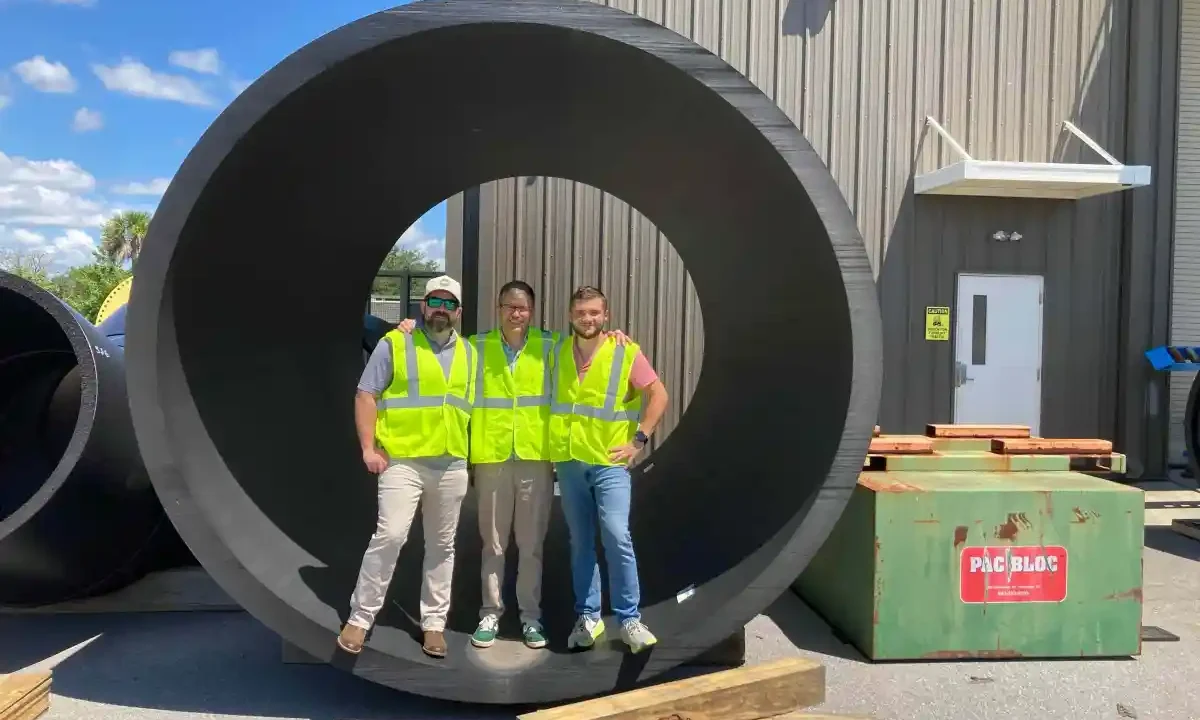
Drogue, a startup based in Washington, D.C., has secured $20 million in funding to develop floating data centers powered by the thermal energy of the ocean. The company, which was established six months ago, aims to address the rapid growth in artificial intelligence demand by offering a solution that bypasses the traditional eight-to-ten-year timelines associated with terrestrial data center real estate and grid integration.
According to co-founder and CEO Sam Sipe, the first prototype, a multi-megawatt system installed on a traditional ocean-going vessel, is scheduled to be deployed in early 2028. Future iterations of the technology will be built on floating structures resembling offshore oil platforms.
The technology utilizes ocean thermal energy conversion (OTEC), a method first conceptualized in the 1950s. The system operates by harnessing the temperature differential between warm surface water and cold deep-sea water, which averages approximately 4 degrees Celsius. Warm surface water is used to cool data center servers, and the heated water is then used to boil ammonia. The resulting ammonia gas drives a turbine to generate electricity, after which it is condensed using cold water drawn from depths of 1,000 meters.
Sipe noted that advancements in manufacturing techniques, particularly regarding pipes and heat exchangers, have made the technology viable today in a way it was not in the 1980s. The startup has identified data centers as the ideal application for this at-sea power generation, as servers are compact and data transmission from the vessel is cost-effective. Each vessel is expected to remain at sea for roughly ten years.
Investors backing the company include XYZ Venture Capital, Toyota Ventures, Tamarack Global, Dream, FDVC, Garuda Ventures, Flexcap, Boost VC, and Slow Ventures. Drogue has obtained a preliminary ‘approval in principle’ from the American Bureau of Shipping and is currently in the process of purchasing a ship to construct its first prototype.



Using ammonia for power sounds risky. What happens when that turbine leaks? Hope they tested safety protocols.
Six months old and already raising? Wild. Hope they actually finish the prototype by 2028 without going bust.