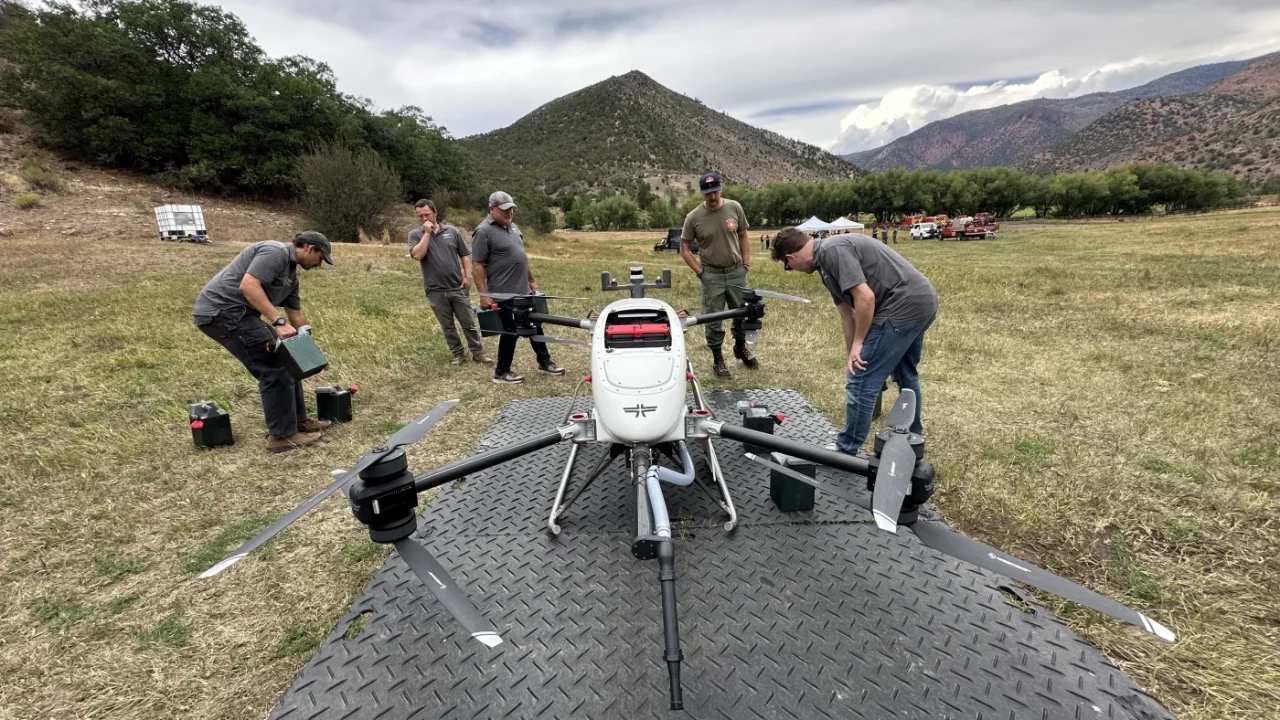
The Aspen Fire Protection District in Colorado is undergoing training to pilot a new generation of AI-enabled firefighting drones, positioning itself as the first fire department globally to operate the technology independently. The devices, developed by California-based company Seneca, are designed to assist in extinguishing fires in remote or difficult-to-access areas, a critical need for the Aspen region which features dense forests and limited evacuation routes.
During recent testing sessions, uniformed staff from the district were observed operating massive drones that resemble giant insects, measuring approximately 10 by 12 feet wide. Each drone can carry between 500 and 1,000 gallons of fire-suppressing foam. The drones are designed to operate in a swarm, similar to a small fire engine, and are controlled via tablets by volunteer firefighters. Andy Fisher, deputy chief of Aspen Fire, noted the ease of use, joking that even a child could operate the machines.
While firefighters have used drones for wildfire monitoring for decades, this new technology integrates an AI-supported sensor suite that calculates distance, wind speed, and required release angles to effectively tamp down flames. According to Stuart Landesberg, Seneca’s founder, the drones can bypass steep or treacherous terrain with a range of five to ten miles, or twice that distance if not carrying a payload. Until now, these drones have only been utilized on prescribed burns in California with direct support from Seneca staff. With the new program launching as early as next year, Aspen Fire aims to deploy these units to attack smoldering fires, such as remote lightning strikes, before they can be exacerbated by wind.

Finally, some innovation in wildfire suppression. The tech has been promising, but actual deployment is what matters now.
Does the AI account for nearby power lines? My area has a lot of utility infrastructure near the forest edges.
Giant insect drones carrying a thousand gallons? Sounds like something out of a sci-fi movie, but practical too.
I hope they test this thoroughly in real fires soon. Prescribed burns are one thing, but wildfire conditions are different.
If volunteers can operate them via tablets, that is incredibly efficient. Reduces training time for new crew members.
The swarm concept is fascinating. Seeing multiple units coordinate simultaneously will probably speed up containment efforts dramatically.
Wait, are these things actually safe in high winds? I worry about losing control when the gusts pick up.
This is huge for mountain firefighting. Reaching those steep valleys is always a nightmare, so this tech sounds like a game changer.