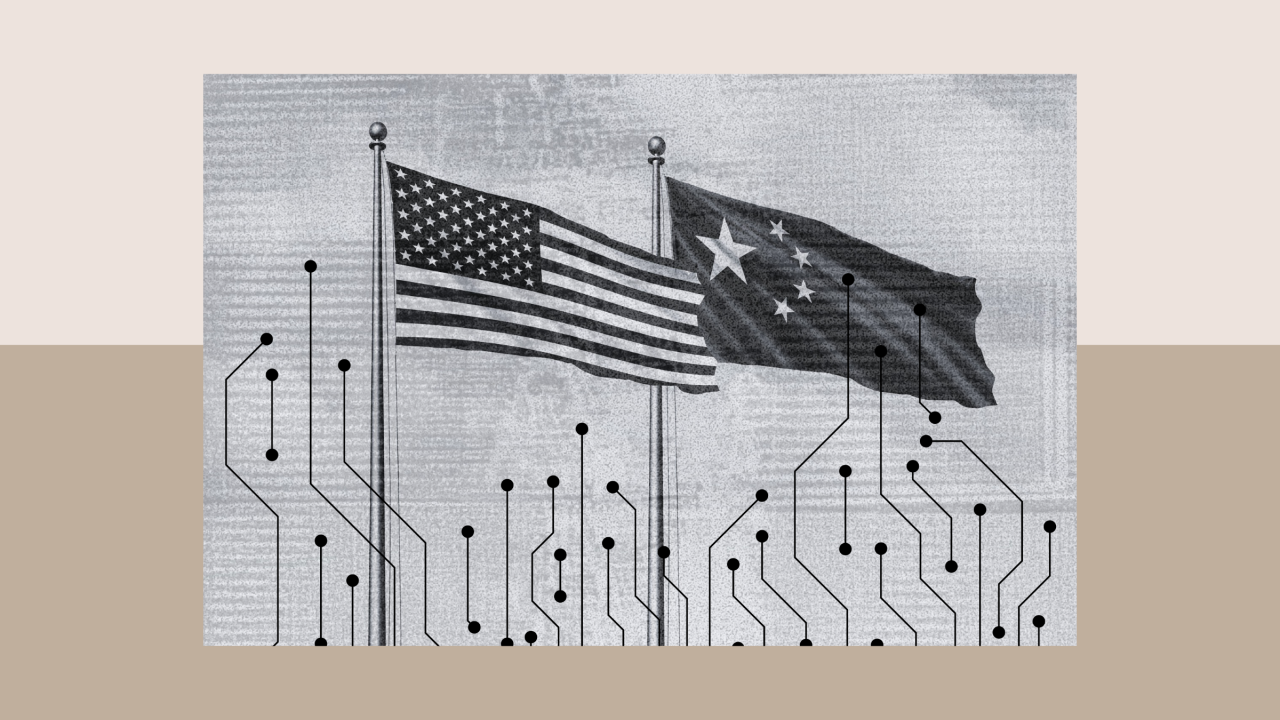
The escalating rivalry between the United States and China in the artificial intelligence sector is creating a significant power vacuum for the rest of the world, leading to increased geopolitical dependency and concerns over cultural homogenization. As the U.S. and China consolidate their dominance in AI development, most other nations are forced to rely on external technologies with limited influence over how these systems are built, tested, or governed.
According to data from Epoch AI, the U.S. captured approximately 72% of the world’s new AI computing capacity between 2022 and June 2026, with China taking 10% and all other countries sharing the remaining 18%. This concentration extends to energy consumption; the International Energy Agency estimates that American and Chinese data centers accounted for about 70% of global electricity use for these facilities in 2024. Research infrastructure is similarly skewed, with a Carnegie Endowment study finding that three-quarters of researchers at a leading AI conference in 2025 were affiliated with employers in the U.S. or China.
Experts argue that this “bipolar” system results in AI that reflects Western and Chinese values, often neglecting the linguistic and cultural needs of the Global South. Analysis of Common Crawl data reveals that while 43% of web pages used for training are in English, only 0.2% are in Hindi, a language spoken by over half a billion people. Consequently, AI models frequently fail to capture local nuances, with users in countries like India reporting that their writing styles shift to mimic American patterns when using these tools. Additionally, a “language tax” exists, where processing tokens in less supported languages like Hindi or Odia costs more than doing so in English.
In response, several middle powers are investing in sovereign AI models to ensure technological independence. India’s Sarvam, Canada’s Cohere, France’s Mistral, and the UAE’s Jais are among the initiatives aimed at creating systems tailored to local contexts. The UAE’s Jais model, for instance, is developed in partnership with G42, a company chaired by Sheikh Tahnoun bin Zayed Al Nahyan, the country’s national security adviser. However, analysts caution that these sovereign models often rely on open-weight architectures from the U.S. or China, potentially inheriting existing biases. Furthermore, the alignment process—where humans rate AI responses to shape behavior—remains skewed toward English-speaking populations, failing to adequately represent global diversity.
Geopolitical tensions are further driving the formation of competing coalitions. Beijing established the World Artificial Intelligence Cooperation Organization in July, while Washington is leading the Pax Silica initiative, pressuring allies to choose sides. In June, the U.S. government temporarily blocked foreign access to Anthropic’s Fable 5 and Mythos 5 models for national security reasons, an event that underscored the fragility of global AI access and accelerated efforts by other nations to build domestic capabilities.
International bodies are attempting to bridge these gaps, with the United Nations and the Global Partnership on Artificial Intelligence (GPAI) working to establish safety protocols and shared standards. Finland proposed measures to manage the pace of AI development at the 81st UN General Assembly, though only 22 countries signed the proposal to keep AI “under human control.” Nigerian officials have expressed urgency regarding productivity gains, arguing that there is no time to wait for extensive regulation. Experts recommend that nations pool resources to build shared regional computing infrastructure and collaborate on robust, multilingual benchmarks to ensure that AI systems serve diverse communities effectively.



The U.S. blocking access to Anthropic models was a bold move. It really highlighted how fragile our global connectivity is.
It feels like the rest of the world is just getting left behind in this massive technological arms race.
Interesting that Finland is trying to regulate this. I hope the UN can actually enforce meaningful safety standards globally.
The energy consumption numbers are terrifying. We are burning through our power grids just to train these massive models.
As an Indian professional, I constantly feel my unique voice is being flattened when I use major AI tools for my work.
Skeptical about these new coalitions. Everyone claims they want independence, but they all rely on American or Chinese open-source code.
I think the sovereign models are a step in the right direction, but will they really succeed without access to top-tier hardware?
The Hindi statistics are shocking. It is ridiculous that a language with half a billion speakers gets so little representation in training data.