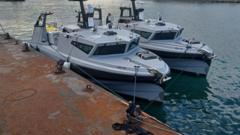
As shipping lanes in the Strait of Hormuz remain hazardous despite US Navy support, maritime experts are turning to autonomous systems to handle the perilous task of detecting sea mines. Steve Cameron, a former merchant navy officer, notes that transiting these waters requires crew consent and specific insurance, with captains making final risk assessments. The threat is not just from aerial attacks but also from underwater mines, which can detonate via acoustic or magnetic signals, damaging or breaking the keel of passing vessels.
According to Ian McFarlane of French defence group Thales, mines are a cost-effective weapon for naval warfare. Traditionally, mine hunting required specialist vessels with crews of approximately 80 sailors. To mitigate the danger to humans, modern operations increasingly rely on autonomous systems monitored from shore, requiring only around 20 personnel. This shift is particularly attractive to NATO navies facing recruitment and retention challenges.
The technology has evolved over two decades, with early applications including the US Navy’s Remus 100 robot during the 2003 Iraq War. Recent conflicts have tested more advanced systems; in early September, Iranian forces captured an uncrewed US autonomous submersible in the Strait of Hormuz. The Pentagon identified the vessel as an Extra Large Uncrewed Underwater Vehicle (XLUUV) from Anduril, stating it was a malfunctioning older device with no classified equipment. Naval analyst William Lupton emphasized that while the capture of the robot had minor tactical implications, it avoided the severe consequences of taking human prisoners.
In response to these threats, global forces are integrating new autonomous technologies. A collaboration between Thales, the Royal Navy, and France’s Marine Nationale has produced the Thales Uncrewed Surface Vehicle (USV). This robot motor launch uses sonar developed for the oil and gas industry to detect mines, towing a sensor box that creates 3D seabed images refined by artificial intelligence. The system is designed to spot modern mines that blend into their surroundings.
Steve Prest, an associate fellow at the RUSI defence think tank and former Royal Navy fleet robotics officer, highlighted that while autonomous systems cannot prove the absence of mines, they significantly reduce risk. He noted that AI now allows for real-time data analysis on the vessels themselves, expanding mission capabilities. Prest advocated for a ‘hybrid navy’ concept where drones operate as part of a distributed force within a ‘cognitive architecture,’ rather than as isolated assets.
The psychological impact of the mine threat remains a significant factor for marine insurance. Neil Roberts of Lloyd’s of London stated that while the US reports the Omani route as cleared and shipments are running at 75% of pre-conflict levels, the uncertainty of underwater threats persists. Robots are increasingly viewed as the primary tool for confronting this fear, allowing for safer navigation through contested waters.


Can these autonomous vehicles distinguish between a real mine and just a rock easily?
Finally some progress in maritime security. The Strait of Hormuz is a nightmare to navigate.
The mention of the captured drone is concerning, but the long-term safety benefits seem worth it.
Robots don’t get scared. That psychological edge is exactly what we need in conflict zones.
Is this technology already available for commercial shipping, or just military navies right now?
Reducing the crew from eighty to twenty people is a massive efficiency gain. Smart move.
I hope these systems are secure. Hacking a mine hunter seems like a nightmare scenario.
The insurance industry will love this shift. Less human risk means much cheaper premiums eventually.
Do we know if these robots can actually work in really rough weather or heavy swells?
It is genuinely exciting to see AI handling such dangerous work. Safer operations for everyone involved.