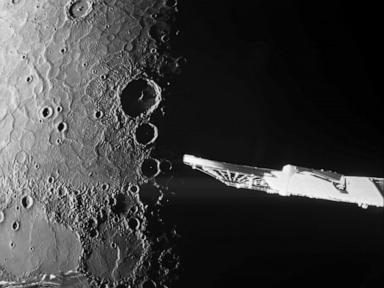
CAPE CANAVERAL, Fla. — The joint European and Japanese BepiColombo mission has successfully entered orbit around Mercury, marking the first time a spacecraft has circled the sun’s closest planet in more than a decade.
The linked pair of spacecraft completed an eight-year journey through the inner solar system before executing thruster firings on Saturday to slow down sufficiently for Mercury’s gravity to capture them. Flight controllers in Germany, located approximately 94 million miles (152 million kilometers) away, confirmed the orbital achievement after several hours of analyzing data transmitted by the probe.
Known as BepiColombo, the $2 billion (1.7 billion euros) mission is composed of one European Space Agency (ESA) craft and one Japan Aerospace Exploration Agency (JAXA) craft. The two units are scheduled to separate next month, allowing them to operate at different altitudes to conduct simultaneous mapping and study of the planet.
Lead project scientist Geraint Jones noted that the mission will enable unprecedented measurements by comparing data from two spacecraft at the planet at the same time. Once separated, the satellites will investigate Mercury’s dense interior, exterior magnetic field, and surface features such as impact craters, volcanic plains, and mountain ridges that reach heights of up to 3 miles (4.5 kilometers).
The spacecraft launched in 2018 and followed a complex trajectory that included flybys of Earth, two passes of Venus, and six flybys of Mercury to utilize gravity assists. This route accumulated over 6 billion miles (10 billion kilometers) of travel before the main probe shed its outer shielding in September for the final approach.
Mercury, which is barely larger than Earth’s moon, experiences extreme temperatures exceeding 800 degrees Fahrenheit (427 degrees Celsius), posing significant engineering challenges. Officials aim to sustain the mission for at least one Earth year, equivalent to four Mercury years, focusing on keeping the sensitive instruments cool. BepiColombo is only the third spacecraft to visit Mercury, following NASA’s Mariner 10 in the mid-1970s and Messenger, which orbited the planet from 2011 to 2015.



Keeping things cool at 800 degrees is no joke. Engineering marvels make this whole thing possible.
Honestly, I forgot Mercury even exists. It’s always been overshadowed by Mars and the Moon lately.
Two ships working together at different altitudes sounds like a really clever setup for detailed mapping.
I can’t believe they managed to capture orbit that far away. What kind of precision was that?
Eight years is a long time to wait for this, but the science data must be incredible. Worth it.