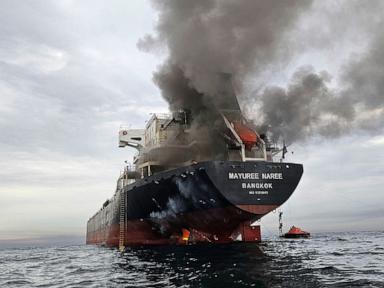
Maritime data indicates that the frequency of attacks in and around the Strait of Hormuz has reached its highest levels since the war between the United States, Israel, and Iran began in late February. The United Kingdom Maritime Trade Operations Centre (UKMTO) recorded 31 attacks in October and approximately 19 in the first two weeks of November, a significant increase from the 53 incidents reported between March and September.
Experts state that these operations appear to be an Iranian strategy to disrupt U.S.-led efforts to ensure the continued flow of oil through the strait, which remains economically vital despite an Iranian-declared blockade. The International Maritime Organization (IMO), a United Nations agency, has confirmed 34 attacks in the same period, slightly more conservative than the UKMTO’s figures, but still marking a sharp rise from the roughly 50 incidents recorded earlier in the year. The IMO has tallied a total of 138 vessel attacks across the Middle East since the start of the conflict.
According to UKMTO data, most attacked vessels were located in the southern portion of the strait, near the Omani coastline. A tanker was hit by an unknown projectile in its engine room on Thursday, November 18, while sailing outbound. Noam Raydan, a senior fellow at the Washington Institute for Near East Policy, told ABC News that Iran’s objective is to keep the U.S.-facilitated Omani route high-risk to prevent consistent energy recovery.
Hamidreza Azizi, a senior Iran analyst at the International Crisis Group, noted that while Washington and regional partners have found ways to keep oil moving, Tehran is determined to make these arrangements costly and unreliable. Sina Toossi, senior fellow with the Center for International Policy, explained that the U.S. workaround involves “ship-to-ship” transfers, where smaller tankers cross with tracking systems off and transfer cargo to larger vessels on the other side. Toossi described the current situation as a cycle of adaptation, with Iran escalating attacks to render this system unviable and apply economic pressure to force negotiations.
U.S. forces have maintained a naval blockade since April 13, with a brief pause in June, preventing Iranian and Iran-linked ships from entering or leaving the Gulf of Oman. The strikes are not limited to active transit; on November 8, satellite imagery confirmed Iranian attacks on the Omani island of Didamar, which houses radar and satellite communications equipment. Iran state media claimed to have struck “enemy navigation aid systems,” though Oman did not comment on the incident.
Verification by ABC News confirmed that ships are being attacked even when not crossing the strait. The Panama-flagged supertanker Gem No. 2, which had been idle off the United Arab Emirates coast for nearly five months while loaded with two million barrels of Saudi crude, was struck by a drone on October 9 and at least three others on October 10, causing a massive fire and evacuation. While the Iranian Revolutionary Guards Corps claimed the ship hit a naval mine, satellite images and crew videos confirmed the vessel was attacked by drones while stationary, well outside the strait. Analysis of debris by Fabian Hinz, a researcher in drone warfare, identified the projectile as a jet-powered Hadid-110, built by Iran.
Analysts suggest that large tankers are being specifically targeted to discourage the use of supertankers and prevent alternative shipping arrangements from undermining the blockade. Samir Madani, co-founder of TankerTrackers.com, noted that Gem No. 2 was an easy target because its location transmission services were active. Azizi stated that Iran is attempting to demonstrate that the U.S. cannot guarantee maritime security in the Persian Gulf, while Toossi warned that this escalation could lead to wider disruptions in regional shipping and energy infrastructure, with significant consequences for the global economy.


This blockade feels like a proxy war played out on the global supply chain. Nobody is winning.
Hadid-110 drones are nasty. Once they get into engine rooms, evacuation is usually too late for everyone.
Iran is clearly trying to break the U.S. workaround. It is a calculated strategy to cause maximum economic pain.
I can’t believe the IMO and UKMTO numbers don’t even match. Which data set should we trust?
Oman is now in the crosshairs too? I didn’t think this conflict would involve neutral coastal infrastructure.
The escalation in November is worrying. We are seeing more attacks in two months than all prior quarters.
Attacking idle tankers is illegal and unethical. You cannot just bomb a ship that is not moving.
It is terrifying to think about the economic ripple effects. Gasoline prices will skyrocket soon if this continues.
The ship-to-ship transfers sound like a recipe for disaster. How do they guarantee safety with tracking systems off?