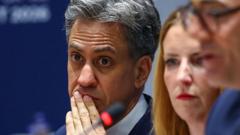
Foreign Secretary Ed Miliband has stated that the comprehensive trade agreement reached between the United Kingdom and the European Union will enter into force regardless of whether the two parties successfully negotiate a separate agreement on tuition fees. Speaking on the BBC’s Sunday with Laura Kuenssberg, Miliband clarified that the measures agreed upon in Brussels last Friday are distinct from the unresolved issue of student funding.
The deal, finalized in Brussels, includes provisions to eliminate most checks on British food exports in exchange for the UK adhering to select EU regulations starting in 2028, alongside the introduction of a new youth mobility scheme. Prime Minister Andy Burnham has described the agreement as a “win-win” scenario that aims to reduce red tape and lower the cost of living, with the Treasury estimating it could contribute up to £17 billion annually to the UK economy.
While the broader framework was agreed upon, the European Commission’s proposal to reduce tuition fees for EU students studying in the UK has not yet been ratified. Commission President Ursula von der Leyen expressed confidence that a solution would be found, a stance echoed by Prime Minister Burnham during the announcement press conference. Miliband emphasized that the food export, energy, and youth mobility agreements are legally binding and that legislation is already being introduced in Parliament to implement the 2028 timelines.
Milibandum addressed the possibility of the UK rejoining the EU, stating that “all the options will be on the table.” He acknowledged the outcome of the 2016 Brexit referendum but noted that the global and European landscape has shifted significantly, warranting a review of the costs and benefits of various options. He further asserted that the new agreements would not result in new contributions to the EU budget, imposing no direct cost on UK taxpayers.
Opposition leaders have reacted sharply to the deal. Conservative leader Kemi Badenoch criticized the agreement as “not fair,” arguing that it subjects UK farmers to Brussels rules and allows EU youth to compete with British workers, while disputing the Treasury’s economic projections. Reform UK leader Nigel Farage condemned the deal as a “betrayal of the British people,” while Liberal Democrat leader Sir Ed Davey argued that the current measures are insufficient and that a more comprehensive new deal is required to effectively improve the UK’s relationship with the bloc.
At least the food export checks are going away. That was a headache for local producers, so this is a win.
Seventeen billion pounds a year? Sounds suspiciously high. I bet the actual savings will be much lower once regulations kick in.
Milibandum’s comments about rejoining the EU are shockingly bold. I wonder if the public is actually ready to hear that again.
Is it really okay to ignore tuition fees? Students will face the same problems in 2028. This feels like a major oversight.