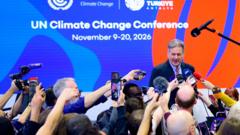
Negotiations at the COP31 UN climate summit in Antalya, Turkey, have reached a stalemate after discussions ran into the night without agreement on a new global deal. The impasse centres on a draft text that currently omits any reference to reducing global demand for fossil fuels, a point of contention for a bloc of nations led by France and Panama.
Juan Carlos Navarro, Panama’s Environment Minister, stated that it was unacceptable for a major climate agreement to exclude any mention of fossil fuels. Echoing this sentiment, France’s Minister of Ecological Transition, Monique Barbut, argued that the document’s focus on carbon capture technology effectively permits countries to continue burning oil and gas, despite the fact that the summit has formally acknowledged the goal of limiting warming to 1.5C has been missed.
The final agreement, tentatively dubbed the Antalya Accords, is expected to be published on Saturday. While island states and several European Union members including Spain, Belgium, Sweden, and Finland are pushing for commitments to phase out coal, oil, and gas, petroleum-producing nations led by Saudi Arabia have advocated for the removal of such language. A potential compromise under discussion involves excluding fossil fuels from the final text in exchange for pledges from petro-states to ensure 35% of their power comes from renewable electricity by 2035.
Separately, the Africa Group is demanding the restoration of financial commitments for climate adaptation. Earlier draft versions included a pledge to increase adaptation funding to $120 billion by 2035, but this has been removed from the current text. Zanetor Agyeman Rawlings, Ghana’s Environment Minister and chair of the African Group, asserted that the group’s presence at the summit was to claim rights for their people suffering from the impacts of developed nations’ activities, rather than to plead for assistance.
Chris Bowen, Australia’s climate change and energy minister, who is leading the negotiations, has argued that the current summit should focus on implementation and the transition to clean energy rather than contentious language. Other European diplomats have largely declined to join the formal rebellion against the draft, viewing such moves as detrimental to the progress of talks.


These summits always stall on language games. Real change only happens when companies actually stop producing oil.
A 35 percent renewable target by 2035 for petro states feels dangerously low given the actual warming data.
Why is Australia leading this? They seem more focused on political maneuvering than actually solving the climate crisis.
The $120 billion adaptation funding cut is insulting. Africa shouldn’t have to beg for help they were already promised.
Removing fossil fuel mentions while keeping carbon capture is just a smokescreen. We need honest phaseout language immediately.