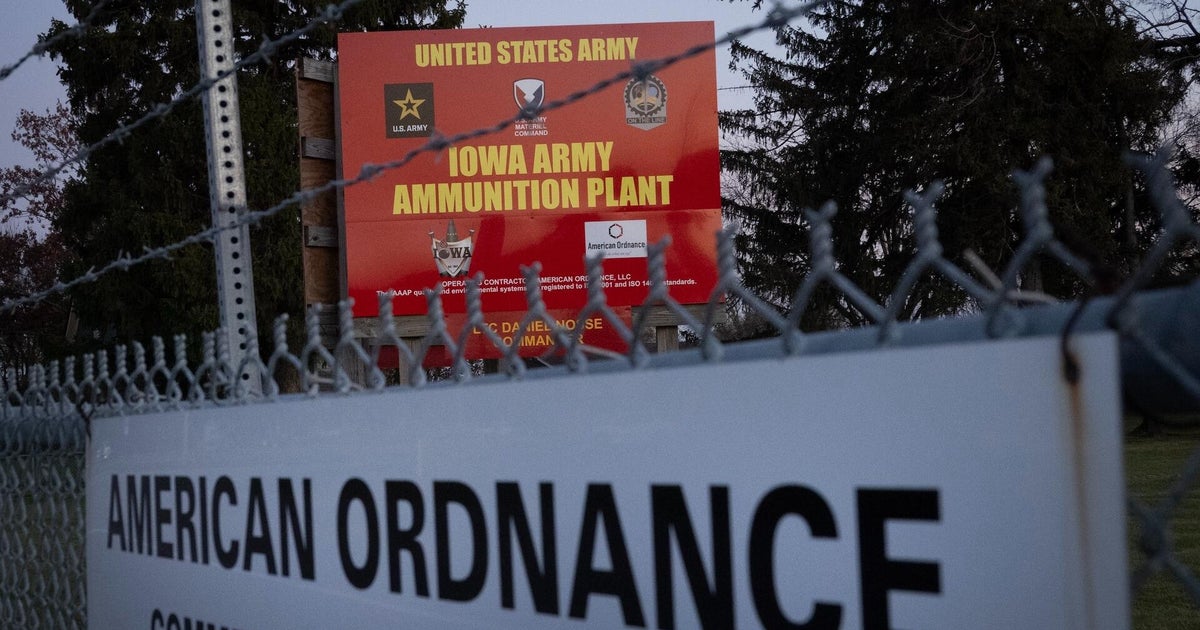
A federal court issued an emergency order on Friday to suspend the U.S. Army’s plan to detonate several tons of unstable explosives at a munitions plant in Iowa, following a lawsuit filed by environmental groups. The 8th U.S. Circuit Court of Appeals granted the motion to pause the demolition of lead azide after community outcry over the potential release of toxic lead particles in a dust plume across Iowa and Illinois.
The controlled explosions were originally scheduled for noon on Friday in Middletown, a rural community of approximately 360 people located about four hours from Chicago. The Army had delayed the event to Monday before the judicial intervention took effect. In March, the Army discovered that 68 drums of lead azide at the Iowa Army Ammunition Plant, a facility established in 1941, had begun to recrystallize. This process creates a highly unstable situation with a significant risk of spontaneous explosion, a danger exacerbated by cold weather conditions.
Lead azide is a sensitive primary initiating explosive that can detonate from minor external triggers such as sparks or friction. Military officials stated that relocation of the materials was not safe and that after modeling four neutralization methods, they concluded a controlled detonation posed the lowest immediate risk to the public. Acting Secretary of the Army Adam Telle emphasized that officials had meticulously planned the event with the Department of Health and Human Services and the Environmental Protection Agency to ensure public safety.
However, local officials and residents argue that communication regarding the approved plan was insufficient, with many learning of the detonation only days prior. Iowa Governor-elect Rob Sand described the lack of clarity as unacceptable, noting it has caused understandable concern and anger among residents. David Cwiertny, a professor at the University of Iowa, explained that while airborne lead may dissipate quickly, lead particles can settle on the ground and enter the food and water supply, posing long-term health risks, particularly to children under the age of six.
Local resident Sean Byers, who lives across from the plant, expressed concern that lead contamination could persist for decades, affecting groundwater and community safety. While the Army stated that mitigation efforts—including detonating the drums inside earth-covered concrete magazines surrounded by two-story-high sand barriers and using water misters—would keep lead levels below EPA protective thresholds, some residents remain skeptical. The Army advised residents to evacuate the area due to noise, ground vibrations, and the dust plume, and offered to replace windows broken by the event. Byers stated he planned to evacuate with his family to Missouri for several days, questioning whether authorities would adequately decontaminate homes exposed to the lead dust.



I hope the water misters actually work. I just want to make sure my kids do not breathe in lead dust.
The Army claims it is safe, but residents learned nothing until days before. That lack of transparency is infuriating.
Why would anyone want to live four hours from a munitions plant? The isolation probably makes safety protocols harder to enforce.
I am shocked they are blowing up toxic chemicals near a rural community. The health risks seem dangerously underestimated.