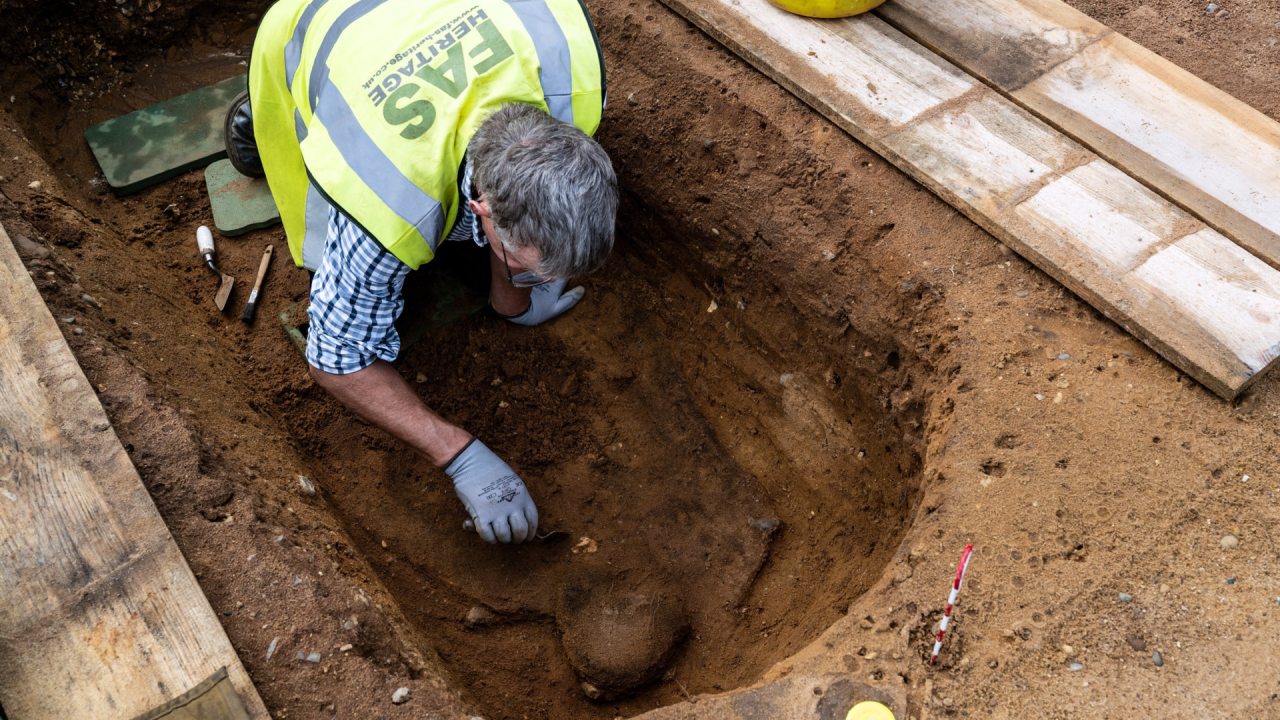
Archaeologists working at the Sutton Hoo Anglo-Saxon cemetery in the United Kingdom have uncovered a rare and mysterious “sand body” burial. The site, located in Suffolk, is best known for its seventh-century ship burial of an early medieval king, but this new discovery highlights the presence of ordinary individuals interred nearby.
The grave, located in a burial ground called Garden Field, contains no skeletal remains. Instead, the acid soil has dissolved the original body and bones, leaving behind a hardened sand cast that preserves the shape of the individual. Angus Wainwright, an archaeologist with the U.K.’s National Trust, compared these “sand bodies” to the preserved bodies found at Pompeii. Such formations have been previously identified at Sutton Hoo and other Anglo-Saxon sites in the region.
The find emerged at the conclusion of a 2025 excavation project, which was documented in a four-part episode of the television series “Time Team.” While a 2024 dig uncovered fragments of a bronze cremation bucket, the 2025 season aimed to better understand the extent of the cemetery and the social connections of those buried there to the occupant of the famous ship burial. That occupant is widely believed to be King Rædwald, who ruled East Anglia and died around A.D. 627.
Wainwright noted that previous research had focused primarily on the royal mounds, whereas the recent work shifts attention to the everyday East Anglians and their ancestors. The team discovered the sand body during the final week of the month-long dig. Accompanying the deceased were various grave goods, including beads, tweezers, a knife, and a brooch. Notably, evidence suggests that a second individual may have been buried directly underneath the first person in the same grave.
Experts believe these sand bodies and associated cremations likely predate the famous ship burial. In the first episode of the “Time Team” series, which premiered on YouTube on Nov. 14, the team also presented new evidence indicating that people buried in the Garden Field cemetery were accumulating wealth and social status, as shown by the interment of at least one individual with a gold ingot. The team additionally investigated remains of a dock used for launching ships into the River Deben and discovered a decorated fragment of a cremation urn, a feature that surprised the researchers.
“It was certainly a high point of this latest dig, to find another of these bodies in the Garden Field cemetery,” Wainwright said. Justin Garner-Lahire, managing director at FAS Heritage, added that at Sutton Hoo, “anything can happen.”


The tweezers and beads are such nice personal details. It really helps you picture the person who actually used them.
Anything can happen at Sutton Hoo, as they said. I bet they found a cat next to that gold ingot too.
What exactly makes the soil so acidic? Is it just natural acidity or something specific to that particular patch of land?
As a Suffolk resident, I always hope they find more of these smaller sites. The daily lives matter just as much as kings.
A second body underneath? That seems odd. Did they really have no room for proper individual graves back then?
The Pompeii comparison is fascinating. Seeing the shape preserved after all these centuries is genuinely creepy and cool.