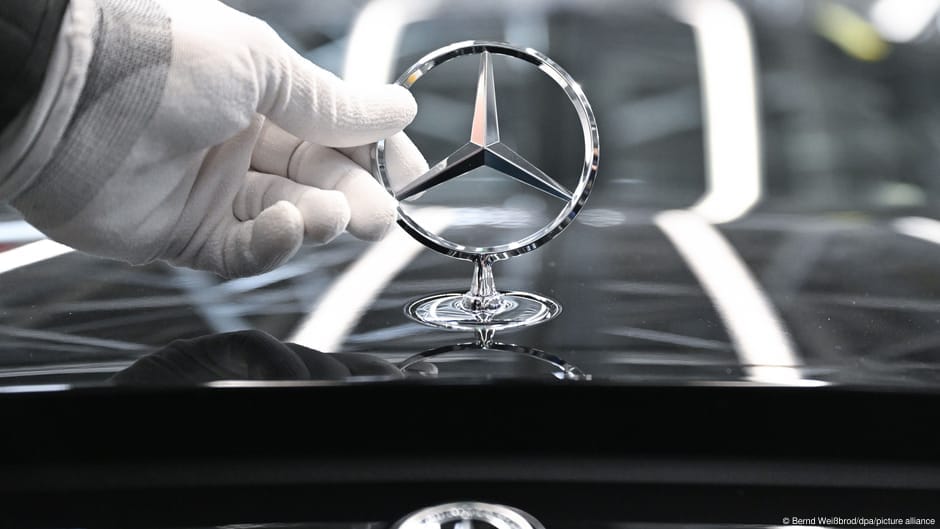
German automakers are facing a critical juncture as major players scale back domestic investments, raising concerns about the future of the nation’s auto manufacturing. Mercedes-Benz announced a freeze on further investments in its German factories, a decision driven by excessive running costs. In a communication to staff, production chief Michael Schiebe stated that the company was forced to assess which German sites might need to close if the cost structure could not be improved.
This move follows recent announcements by Volkswagen, Europe’s largest carmaker, which shelved plans to modernize its Wolfsburg plant. The German auto industry is currently navigating a deep crisis characterized by intense competition from Chinese manufacturers. Volkswagen alone aims to reduce its global workforce by 100,000 jobs by 2030, with four German facilities marked for potential closure.
Despite the grim outlook, industry experts argue that the sector has not reached its end. Thomas Puls, a senior economist at the Cologne Institute for Economic Research (IW Köln), noted that approximately one-third of German production capacity is excessive and must be trimmed. A report by consultancy Roland Berger suggests that while the industry will shrink, it can preserve a profitable core through specialization. However, this requires overcoming significant structural hurdles.
Achim Kampker, a professor at RWTH Aachen University, highlights a stark contrast in industrial agility. While German manufacturers take between 48 to 60 months to bring new models to market, Chinese competitors achieve this in roughly 20 months. Additionally, Chinese firms hold a 30% cost advantage, with production costs in Germany ranging from €3,500 to €5,000 per vehicle compared to €2,000–€2,500 in Eastern Europe.
PwC’s September report warns that German carmakers may be operating under a “false sense of security.” The consultancy recommends four key strategies for survival: separating internal combustion and electric vehicle businesses, reinvesting traditional profits into new technologies, reforming workplace culture, and leveraging partnerships with Chinese and US firms. Harald Wimmer, PwC’s global automotive leader, emphasized that the industry’s viability hinges on decisions made within the next 12 to 18 months, noting that competitors like Xiaomi are now benchmarking themselves against electronics giants rather than traditional auto rivals.
Currently, Mercedes-Benz’s investment halt is linked to negotiations with unions regarding labor costs, including the 35-hour workweek; a deal could lift the freeze. Despite these challenges, German car production remains relatively resilient, with the sector on track to produce 4.11 million vehicles this year, only a 1% drop from the previous year. Analysts warn that German policymakers and unions must avoid repeating the mistakes of Italy in the 2000s, where political and union blockages prevented necessary capacity cuts at Fiat.



Haha, Germans complaining about production costs while driving cars that take half the time to make. Wake up.
Foolish to freeze innovation now. You need the R&D muscle to survive this transition period. Short-termism kills industries.
They always say they are too expensive, but union deals might change that. I hope they don’t shut down prematurely.
Is it too late for VW? Losing a hundred thousand jobs feels catastrophic for the entire automotive sector globally.
Twenty months versus sixty? That speed difference is terrifying. No wonder Chinese brands are flooding the market so fast.
Sad to see my hometown plant shelved. German engineering is proud but the cost gap makes this decision necessary.