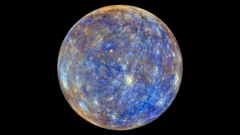
The BepiColombo spacecraft is on the verge of concluding its eight-year journey to Mercury, having traveled nearly six billion miles (10 billion kilometers). The mission, which launched from French Guiana in 2018, is preparing to enter orbit around the solar system’s closest planet to the Sun, despite the environment’s extreme conditions that range from temperatures of 430C to -180C and intense solar radiation.
The original timeline for the voyage was seven years, but a delay in the propulsion system extended the journey by one year. To counteract the Sun’s gravitational pull, the spacecraft followed a complex trajectory, looping around Earth once, Venus twice, and Mercury six times before its final maneuver to secure orbit.
According to Prof. Emma Bunce of the University of Leicester, a principal investigator on the mission, Mercury has historically been an under-explored planet. The spacecraft is expected to investigate key mysteries, such as the presence of ice in polar craters and the formation of shallow surface features known as hollows, which are distinct from impact craters and relatively young in geological terms.
The mission also aims to understand why Mercury possesses a disproportionately large metal core for its small size. One hypothesis suggests that the planet’s mantle was stripped away by collisions early in its history, while another proposes it formed in a metal-rich region of the early Solar System. Previous visits to Mercury were limited to the US-led Mariner-10 flyby in the 1970s and the Messenger mission, which orbited the planet for four years starting in 2011.
BepiColombo is a joint mission between the European Space Agency (ESA) and the Japanese Space Agency (JAXA). Upon arrival, the two spacecraft components will separate: one will conduct close-up surface studies while the other will observe from a greater distance. Engineers at Airbus described the separation mechanism as a critical and delicate process designed to withstand years of space radiation and thermal stress.


Six billion miles. I can’t even comprehend that distance. Space really is vast and we are just tiny dots.
The hollows are still a mystery to me. Are they really that young? It feels like the surface changes too fast.
Finally someone besides NASA is doing serious Mercury work. JAXA and ESA collaboration should yield some really cool findings.
Two spacecraft separating after eight years? That is incredibly risky. I hope the mechanism works perfectly on the first try.
Mercury’s core is huge. If it was formed in a metal-rich zone, that changes everything about early solar system history.
Did someone mention the propulsion delay? That one extra year probably cost a small fortune in maintenance and fuel.
Eight years is a long time. My kid was born when this launched. Can’t wait to see the ice data.
The temperature swing from 430C to -180C is insane. How does the electronics even survive that without melting or cracking?