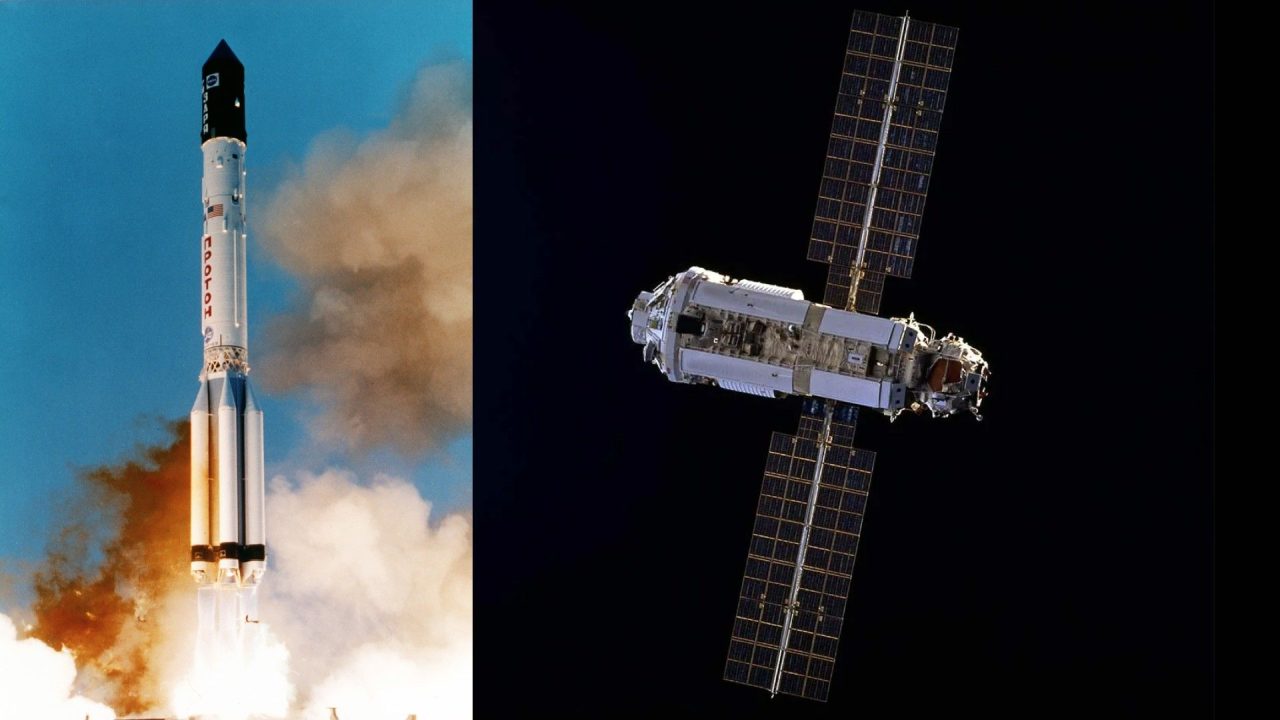
On November 20, 1998, construction of the International Space Station (ISS) commenced with the launch of the Zarya module aboard a Russian Proton rocket. This 42,000-pound module, roughly the size of a tour bus, served as the foundational core of the largest human-built structure in orbit.
Two weeks after the Zarya launch, NASA’s Space Shuttle Endeavour conducted the STS-88 mission to deliver the Unity module. Astronauts connected the two sections in orbit, marking the first significant assembly step for the station. Although built by Russian engineers, the Zarya module was funded by the United States. NASA contracted the Russian facility to manufacture the component at approximately half the cost projected for an American counterpart from Lockheed Martin.
The Zarya, officially designated as the Functional Cargo Block (FGB), was constructed between 1994 and 1998 at the Krunichev State Research and Production Space Center in Moscow. NASA paid $220 million for its development. The module features a habitable volume of 1,650 cubic feet, two solar arrays for power, and 16 external tanks for propellant storage. Currently, it primarily functions for storage and fueling, while its docking ports accommodate Russian Soyuz crew transports and Progress cargo vehicles.
While the initial 1998 configuration offered limited space, the station has since expanded significantly. The arrival of Russia’s Zvezda service module in 2000 allowed the ISS to house its first permanent crew of three astronauts on Expedition 1. Over the subsequent 28 years, contributions from Russia, NASA, Europe, Canada, and Japan have added metal trusses, solar wings, and additional modules, expanding the living area to the size of a football field. Today, the ISS regularly hosts up to seven crewmembers, representing a milestone of continuous human presence in space that has been maintained since 2000.


I remember watching that first launch with my kids. It felt like the future arrived.
Fifteen years after the start, we only had room for three people. The growth was rapid.
The collaboration between these nations was a huge relief during the tensions of the late nineties.
A tour bus in space? I feel like I would be so claustrophobic by day two.
Still cannot believe we have kept humans up there nonstop for that many years without issue.
The fact that it started as just one module is honestly quite impressive to me.
Buying Russian hardware to save money always seemed like a massive strategic gamble back then, but it worked.
Did the Zarya module really just sit there waiting for Unity? How long was that gap exactly?
It is wild to think that the very heart of the ISS was actually paid for by NASA.