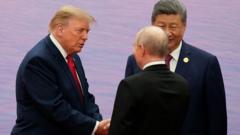
Chinese President Xi Jinping has orchestrated a significant diplomatic event by convening US President Donald Trump and Russian President Vladimir Putin for a trilateral meeting in Shenzhen. The summit, held ahead of the Asia-Pacific Economic Cooperation (APEC) dinner on November 18, 2026, marks a departure from the traditional world order shaped by Washington and Western allies, positioning China at the center of global political and economic conversations.
The meeting took place against the backdrop of Shenzhen’s rapidly advancing technology, featuring driverless cars, drones, and robotics, serving as a display of China’s modernization. While officially an economic summit, the event underscores Beijing’s role in reshaping international dynamics. However, the gathering presents Xi with delicate challenges, particularly regarding the war in Ukraine, which is now in its fourth year.
Beijing is striving to maintain a neutral stance on the conflict, calling for a political settlement while avoiding direct condemnation of Russia’s invasion. This balancing act is critical as China seeks to protect its trade relationships with the European Union, a vital market for its export-dependent economy, without destabilizing its relationship with Moscow. US and European officials have accused China of supporting Russia’s war effort through component supplies and energy purchases.
Another focal point of the summit is nuclear arms control. President Trump has expressed a desire to discuss limiting global nuclear arsenals, a topic complicated by China’s rapid expansion of its nuclear capabilities. With the US-Russian New START treaty expiring in February of this year, concerns over a new arms race have emerged. Beijing has resisted inclusion in new limit agreements, arguing that its smaller arsenal should not face the same constraints as Washington and Moscow, and that it retains the right to develop its strategic deterrent independently.
Furthermore, the unpredictability of the other two leaders poses a risk to Xi’s carefully managed diplomatic optics. Both Trump and Putin have independent agendas, raising the possibility that they may dominate the proceedings, potentially diminishing Xi’s projected role as the primary architect of the moment. The contrast between the stability Xi projects and the ongoing conflicts involving the US and Russia could highlight China’s image as a senior global statesman.
Domestically, the summit offers a propaganda opportunity for Xi as he prepares for the Communist Party Congress next year, where he is expected to seek a fourth term. The Chinese government faces significant internal pressure, including a property crisis, local government debt, slowing manufacturing, and high youth unemployment, with one in five young people struggling to find work. By hosting such a high-profile international gathering, Beijing aims to counter domestic frustrations and reinforce the narrative that China has moved beyond its “century of humiliation” to become a decisive shaper of the new global order.

Historic moment for sure, but will it survive the next Communist Party Congress challenges?
China trying to play neutral on Russia while buying energy is a very delicate balancing act.
The driverless cars and drones they showcased were definitely part of the modernization narrative.
Trump and Putin dominating the conversation would totally undermine Xi’s diplomatic goals here.
One in five young people unemployed? Hosting leaders while domestic issues fester feels hollow.
Hosted ahead of APEC dinner, smart strategic timing for Beijing to claim center stage.
Concerned about the nuclear arms control angle since the New START treaty is expiring soon.
Does anyone think this will actually change the outcome of the Ukraine war or just optics?
Shenzhen hosting the trilateral summit really showcases their tech infrastructure to the world, impressive display.