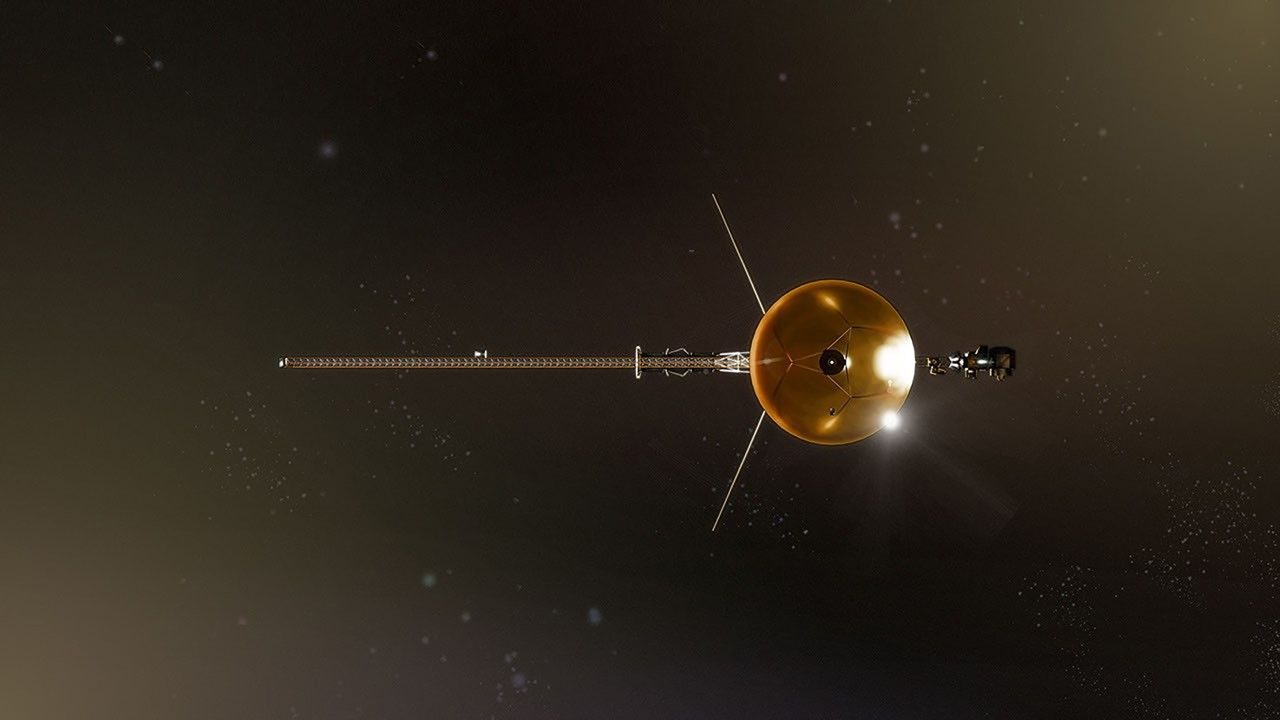
NASA’s Voyager 1 spacecraft, launched in September 1977, has traveled far enough into deep space that it now takes light a full day to travel between the probe and Earth. This distance, known as one light-day, marks a significant milestone in the craft’s epic voyage and raises questions about the forces affecting its continued trajectory.
To understand this vast scale, scientists utilize various units of measurement. While the Astronomical Unit (AU) measures distances within the solar system, and the parsec is used for stellar distances, the light-day offers a intuitive way to comprehend interstellar space. One light-day is approximately 2.6 x 10 to the power of 13 meters. Based on its travel since 1977, Voyager 1 has maintained an average speed of roughly 164 kilometers per second, or 36,000 miles per hour, assuming a straight path.
The spacecraft is influenced by several forces, primarily gravity. The Sun exerts the most significant gravitational pull on Voyager 1, an attractive force equivalent to the weight of 78 grains of salt on Earth. Other factors, such as solar wind and magnetic fields, also affect the probe as it transitions from the heliosphere into the interstellar medium. Although Jupiter exerted a strong influence when Voyager 1 flew by in 1979, its gravitational effect has diminished as the spacecraft moved farther away.
According to Newton’s second law of motion, these forces cause the spacecraft to slow down. The Sun’s gravity results in a slight deceleration of about 0.012 meters per second per day. However, Voyager 1 will not stop. It is moving faster than the escape velocity required at its current distance, which is approximately 3.2 kilometers per second. This speed allows it to escape the Sun’s gravitational pull and continue traveling indefinitely, unless it encounters unexpected interstellar debris.



It’s kind of funny that the sun only pulls with the weight of a few grains of salt.
Skeptical about it avoiding debris, though. Space seems emptier than it actually is sometimes.
The fact that it still works after all these years feels like a genuine miracle of engineering.
Wait, does this mean we are literally talking to it with a full 24-hour delay right now?
I just checked the math on the light-day distance. It is honestly mind-bending how far that probe actually is.