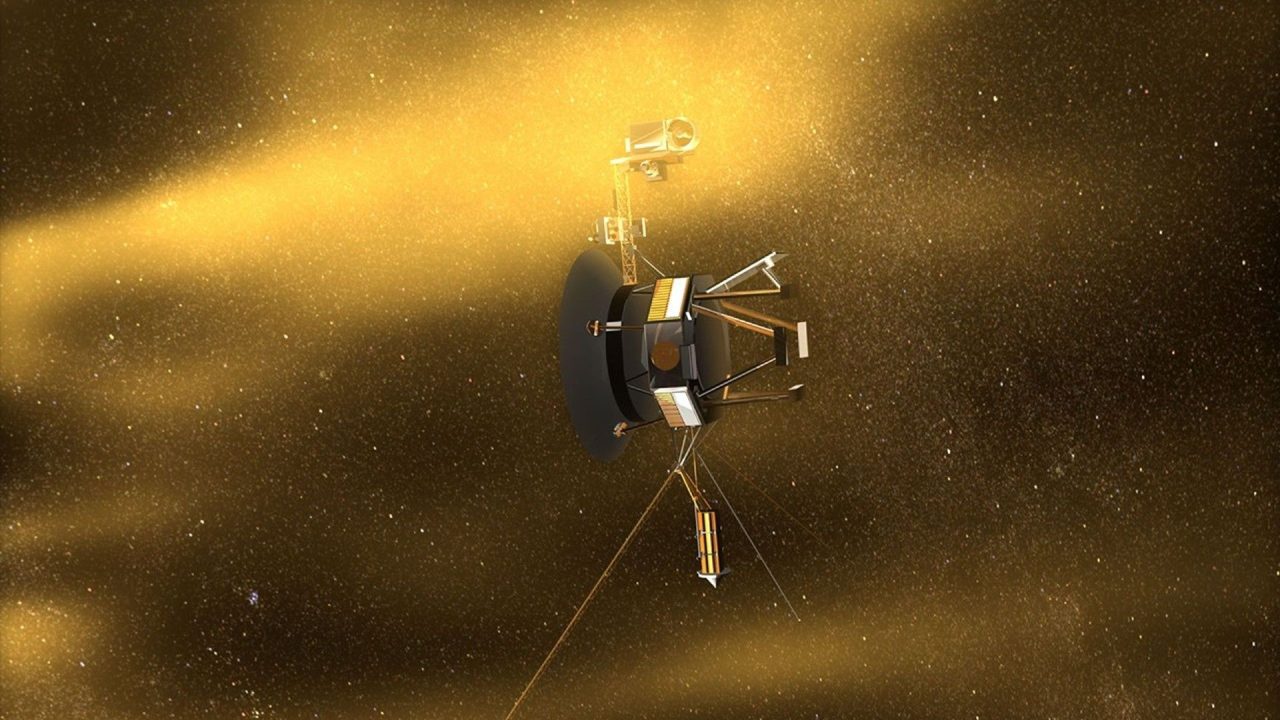
NASA’s Voyager 1 spacecraft has reached a significant milestone in its interstellar journey, traveling to a distance where it now takes a full day for radio signals to travel between Earth and the probe. This means that commands sent from the ground require 24 hours to reach the spacecraft, a feat of long-distance communication never achieved with a robotic mission before. The probe achieved this mark on November 18, continuing its outward trajectory through the heliosphere.
Launched in 1977 along with its twin, Voyager 2, the spacecrafts initially conducted flybys of Jupiter, Saturn, and in Voyager 2’s case, Uranus and Neptune. Voyager 1 took a faster path out of the solar system, crossing into interstellar space in August 2012, while Voyager 2 entered the same region in November 2018. As these probes move further away from the sun, scientists are focused on measuring how magnetic fields, plasma density, and energetic particles change in the pristine environment of interstellar space.
Suzanne Dodd, project manager for the Voyager missions at NASA’s Jet Propulsion Laboratory (JPL), stated that the current scientific objective is to understand how solar phenomena, such as shocks and pressure fronts, affect the surrounding medium. “Where does the sun’s influence end and pristine interstellar space begin? Perhaps Voyager may last long enough to answer that question,” said Linda Spilker, the JPL project scientist. The team is also monitoring the direction of the magnetic field as it shifts from solar to interstellar orientation, a development that was not anticipated at the time of the launch.
However, the mission faces increasing challenges related to power management. Each Voyager spacecraft loses approximately four watts of power annually due to the decay of its nuclear power source. Launch power was 470 watts, and this decline has forced engineers to shut down instruments and implement a power redistribution strategy earlier this year to preserve remaining systems. JPL representatives noted that power margins are “very thin,” particularly as the spacecraft operate in the extreme cold of interstellar space. The team does not expect major operational changes until after the 50th anniversary of each launch, which will occur in August and September of next year.
Recent operations have also dealt with unexpected technical issues, including a roughly 48-hour glitch last month where Voyager 1 temporarily stopped responding to commands, though it recovered quickly. The mission team, representing multiple generations of engineers, remains committed to maximizing the scientific output of the probes. Kareem Badaruddin, the JPL mission manager, highlighted the contributions of both junior and senior staff, including Nshan Kazaryan, who manages Deep Space Network tracking schedules, and Jack Lippincott, who provides expert guidance on data interpretation.
“It has taken decades of exceptional engineering to get Voyager 1 to the one light-day milestone, and hopefully much further before the mission ends,” Dodd said. Spilker added that this distance is special because it represents a new frontier in human contact with deep space, noting that such a feat “may never happen again.”



Sad to hear the power is running out. These little probes have truly outlived their original 5-year mission plans.
A full day delay is wild. Imagine texting your robot grandma in space and waiting 24 hours for a reply.