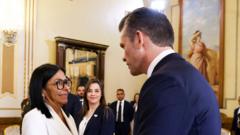
The United States and Venezuela formally re-established military ties on Wednesday, less than a year after US forces captured former leader Nicolás Maduro during a raid on the capital. The interim government, led by former Vice President Delcy Rodriguez, signed a military cooperation agreement with US Secretary of Defense Pete Hegseth at Miraflores Palace.
While specific details of the accord remain limited, the two officials emphasized a shift from adversarial relations to a cooperative security partnership. Rodriguez stated that the agreement aims to address “common threats” and improve operational equipment and technological access for Venezuelan armed forces. Hegseth noted that Venezuela has transitioned “from our most aggressive regional threat to a compliant security partner” in under twelve months.
The signing of the deal marks a significant diplomatic turn following the termination of military cooperation in 2005 by then-President Hugo Chávez, who accused the US of spying and conspiracy. Relations deteriorated further under Maduro, reaching a nadir when the US offered a $50 million reward for his capture before executing the military seizure on January 3.
In a speech at the US Embassy in Caracas, Hegseth reflected on the geopolitical shift, stating: “Just one year ago, my presence here, our presence here would have been deemed impossible… Exactly one year ago today, the indicted narco-terrorist fugitive Nicolás Maduro… yelled mockingly: ‘Come and get me!’ Well, we answered that call.”
Hegseth also issued strong warnings to groups he described as “narco-terrorists” utilizing Venezuela as a safe haven, declaring that US forces would “hunt you down, find you, and kill you.” Following his meeting with Rodriguez, Hegseth traveled to neighboring Colombia, reinforcing the US-led Americas Counter Cartel Coalition and reaffirming the strengthened partnership with President Abelardo de la Espriella, while emphasizing respect for Colombian sovereignty and law.
Respecting Colombian sovereignty while running a counter-cartel coalition sounds contradictory. How does that actually work on the ground?
The $50 million bounty followed by a handshake is the weirdest geopolitical plot twist I have ever seen.
I am curious how the Venezuelan public feels about this. Did they vote for a military alliance with the US?
Hegseth’s speech sounded more like a threat than a diplomatic address. Are we just replacing one bully with another?
It is great to see some stability returning to the region, even if the history of the switch was so violent.
The phrase ‘compliant security partner’ gives me real chills. Does that mean they are just doing what Washington wants?
Can’t believe this happened so fast. From capture to formal military partnership in under a year is shocking.