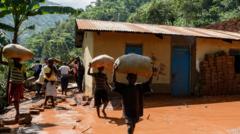
Survivors of a catastrophic landslide that struck Bududa district in eastern Uganda in 2019 have escalated their campaign for justice to the United Nations. The 48 complainants argue that the Ugandan government failed to implement effective disaster management measures, thereby violating the country’s constitution.
The 2019 disaster claimed the lives of more than 53 individuals, including 33 children, in a region that has previously suffered similar tragedies, with over 142 deaths recorded in landslides between 2010 and 2018. For survivors like William Tsama, who lost four family members, the threat of recurrence remains a daily anxiety, particularly during periods of heavy rainfall.
This legal action, initiated in 2020 and supported by the environmental organization Greenwatch, is considered a pioneering case before the UN Human Rights Committee. It seeks to establish a global precedent regarding climate adaptation measures, demanding that governments account for loss and damage in their disaster management policies rather than treating it as an afterthought.
The petitioners are requesting compensation for lost lives and livelihoods, as well as immediate implementation of early-warning systems in high-risk zones. Samantha Atukunda Kakuru Mwesigwa, Executive Director of Greenwatch, stated that the goal is to force government policy to align with the changing climate, ensuring that vulnerable populations are protected. The complainants also highlight that shifting rainfall patterns and declining soil fertility have severely impacted local farming, further destabilizing livelihoods.
While Uganda introduced a resettlement plan in 2011, progress has been slow. A new program launched last month offers affected households 18 million Ugandan shillings (approximately $4,300) to facilitate relocation. This package allows families to choose between receiving two acres of land valued at 8 million shillings plus a 10 million shilling housing grant, or a cash equivalent. The scheme aims to assist 1,410 households identified as living in danger zones.
However, the government has given residents two months, from November to December, to vacate designated high-risk areas or face forced eviction. Many survivors question whether the compensation provided is sufficient to rebuild their lives and protect their land rights. Legal experts note that such disasters are exacerbated by climate change, with similar recent tragedies in Kenya, Rwanda, and Nepal highlighting the disproportionate impact on poorer nations that have contributed less to global emissions.


Could this actually set a binding precedent for other African nations? I hope the UN takes it seriously.
Forced eviction by December? That timeline is terrifying. Most families won’t have time to plan properly.
Climate change disproportionately hurts the poor. Uganda contributed almost nothing to emissions yet suffers the consequences.
Five years later and still no real progress. The $4,300 payout feels insultingly low for those losses.