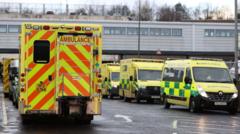
The two-hour ambulance handover limit for emergency departments is expected to be “very challenging” to maintain during the upcoming winter season, according to a senior medical specialist. The “Release to Rescue” initiative, launched this year, mandates that patients be transferred from ambulances to hospital beds within a maximum of two hours, a measure designed to free up crews for urgent calls. However, data indicates that the target was breached more than 2,000 times between May and August, covering the first four full months of the scheme’s implementation.
The Department of Health noted that the scheme has yielded “improvements,” citing a reduction in waits of two hours or more compared to the same period last year, when there were over 6,000 such delays. Despite these gains, the protocol faced significant strain recently. On September 1, the South Eastern Health Trust temporarily paused the initiative at the Ulster Hospital following an “exceptionally busy” bank holiday Monday, during which 23 ambulances exceeded the two-hour limit. This incident marked the first time a health trust has suspended the policy since its introduction.
One case highlighted the severe impact of the backlog on patients. William Murphy, an 85-year-old resident of County Down, waited more than 12 hours for an ambulance after falling ill at home in September. His son, Ronnie, described the situation as alarming, noting that his father was “completely off his feet” and his oxygen levels were “severely low” by the time he reached the hospital. The Northern Ireland Ambulance Service (NIAS) apologized for the delay, stating that demand for their services currently “exceeds our capacity to respond in as timely a manner as we would like.”
Dr. Michael Perry of the Royal College of Emergency Medicine argued that a specific two-hour handover protocol should not be necessary if hospital systems are functioning efficiently. “If we had a flowing system where patients moved in a timely fashion… ambulances would offload as soon as they arrive,” Perry said. He warned that seasonal winter illnesses are set to increase demand on emergency departments, making the offloading process even more difficult.
Financial pressures are also contributing to the issue. The Department of Health has requested all six health trusts to identify up to 12% in savings over three years. A NIAS savings plan published in August indicated that £5.2 million in budget cuts for the 2026-27 financial year is “dependent on the successful continuation” of the Release to Rescue initiative. Union representative Norman Cunningham highlighted the persistent structural challenge, noting that ambulance demand increases by 3% to 5% annually, leaving critically ill patients at home without timely transport while crews are stuck outside hospitals.
While the South Eastern Health Trust reported that 90% of ambulances were turned around in under two hours in August, other trusts have maintained their commitment to the protocol. The Southern, Northern, Western, and Belfast Health Trusts all stated that they have not paused the initiative, although the Southern Trust acknowledged that it “may on occasion be breached due to day-to-day service pressures.”


Interesting that Ulster Hospital paused it first. Hopefully, other trusts learn from that immediate strain.
Cutting budgets while demand rises is a recipe for disaster. The savings target is completely unrealistic.
Twelve hours for an 85-year-old? That is terrifying. NIAS clearly has no capacity left for peak demand.
Six thousand fewer delays is progress, but two thousand breaches still sounds catastrophic. We need better hospital throughput.
Winter is coming and I am genuinely scared for my parents. How is this sustainable with current staffing levels?