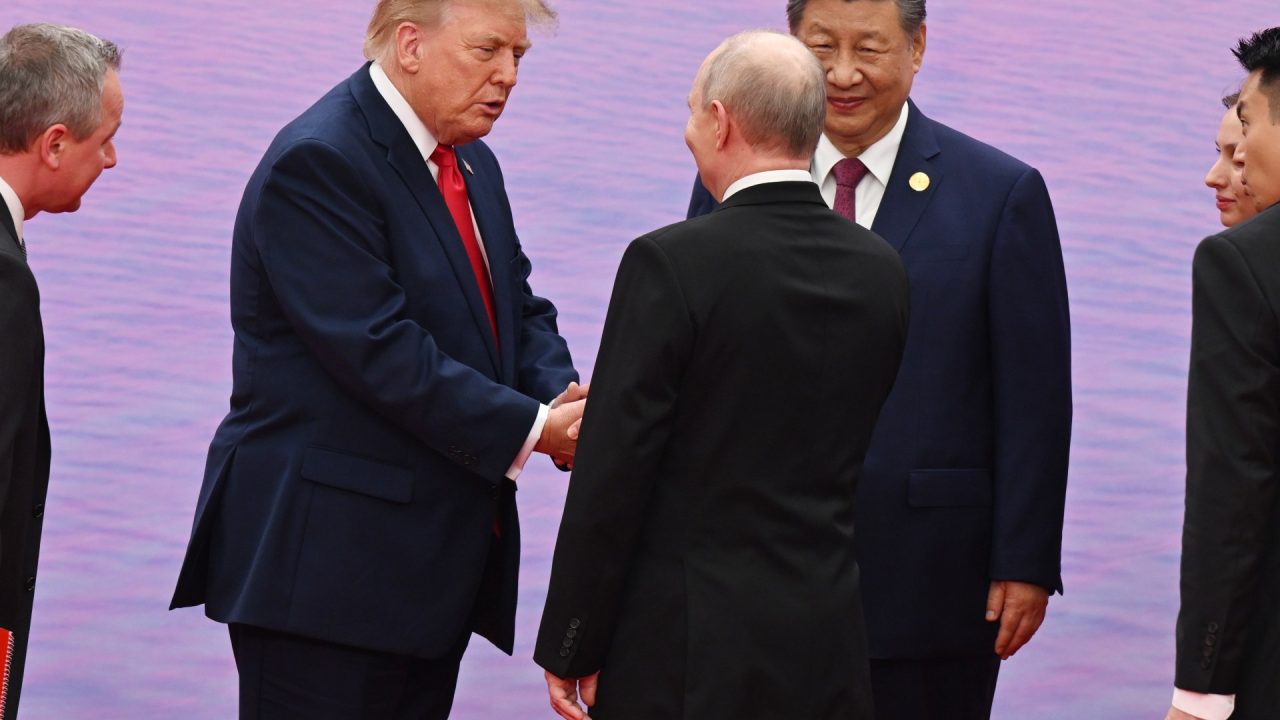
A tripartite meeting between US President Donald Trump, Russian President Vladimir Putin, and Chinese President Xi Jinping, reportedly planned for the Asia-Pacific Economic Cooperation summit in Shenzhen, has drawn comparisons to historic diplomatic milestones such as Yalta and Reykjavik. While some view the gathering as a potential “Yalta 2.0” focused on global reordering, other analysts frame it as “Reykjavik 2.0,” echoing the 1986 dialogue between Ronald Reagan and Mikhail Gorbachev that nearly eliminated all nuclear weapons.
Dmitri Trenin, president of the Russian International Affairs Council and former director of the Carnegie Moscow Center, has suggested that an unprecedented trilateral meeting would be most effective if centered on denuclearization. He noted in a piece for Al Jazeera that Russia could play a constructive role in negotiating a new nuclear agreement between the United States and its ally Iran. However, some experts argue the leaders should aim higher, seeking to rekindle the spirit of the 1986 Reykjavik meeting, where Reagan and Gorbachev came within a single word of agreeing to eliminate all nuclear weapons.
That historic opportunity reportedly slipped away when Reagan insisted on unlimited testing of the Strategic Defense Initiative rather than limiting it to laboratory settings for ten years. Despite significant obstacles, there are arguments suggesting all three current leaders could support a new disarmament proposal. Trump, following a setback in midterm elections, may be seeking a major legacy-defining achievement. In February 2025, he stated there was no reason for the US to build new nuclear weapons, citing the excessive destructive capability already present. He has previously described nuclear capability as the “single biggest problem” facing the world, a view he attributes to advice from his late uncle, MIT physicist John Trump.
Trump also claimed in January 2025 that both Putin and Chinese leadership had expressed interest in reducing nuclear arsenals, noting that “denuclearisation” is a viable goal. Similarly, Putin affirmed in 2017 that universal nuclear disarmament is possible and that Russia wishes to achieve it. Additionally, the leaders of the US, Russia, China, France, and the UK jointly declared before the 2022 invasion of Ukraine that a nuclear war cannot be won and must never be fought, reaffirming commitments to the Nuclear Non-Proliferation Treaty.
President Xi Jinping has stated that nuclear weapons should be completely prohibited and ultimately destroyed, though China has indicated it will not join arms control talks until the gap between its arsenal and those of the US and Russia narrows. Proposals have emerged suggesting the US and Russia reduce their arsenals to the approximately 600 weapons China currently possesses, followed by a phased elimination process. This would involve three four-year stages, starting with US and Russian reductions while China pauses expansion, followed by multilateral negotiations to join the Treaty on the Prohibition of Nuclear Weapons, and concluding with final elimination and verification, potentially in time for the centennial of the United Nations.
As John Kennedy noted, “Our problems are man-made – therefore, they can be solved by man.” While the path to ending the nuclear age remains complex, the upcoming trilateral summit presents a rare opportunity for the world’s major powers to prioritize disarmament over the accumulation of destructive capabilities.

Calling this Yalta 2.0 feels dramatic. It is just a business meeting with some nice diplomatic packaging.
Hopeful it works, but trust issues are high. How do we verify all those warheads are actually gone?
The China limitation makes sense. They won’t join talks until the arsenal gap between US and Russia is closed.