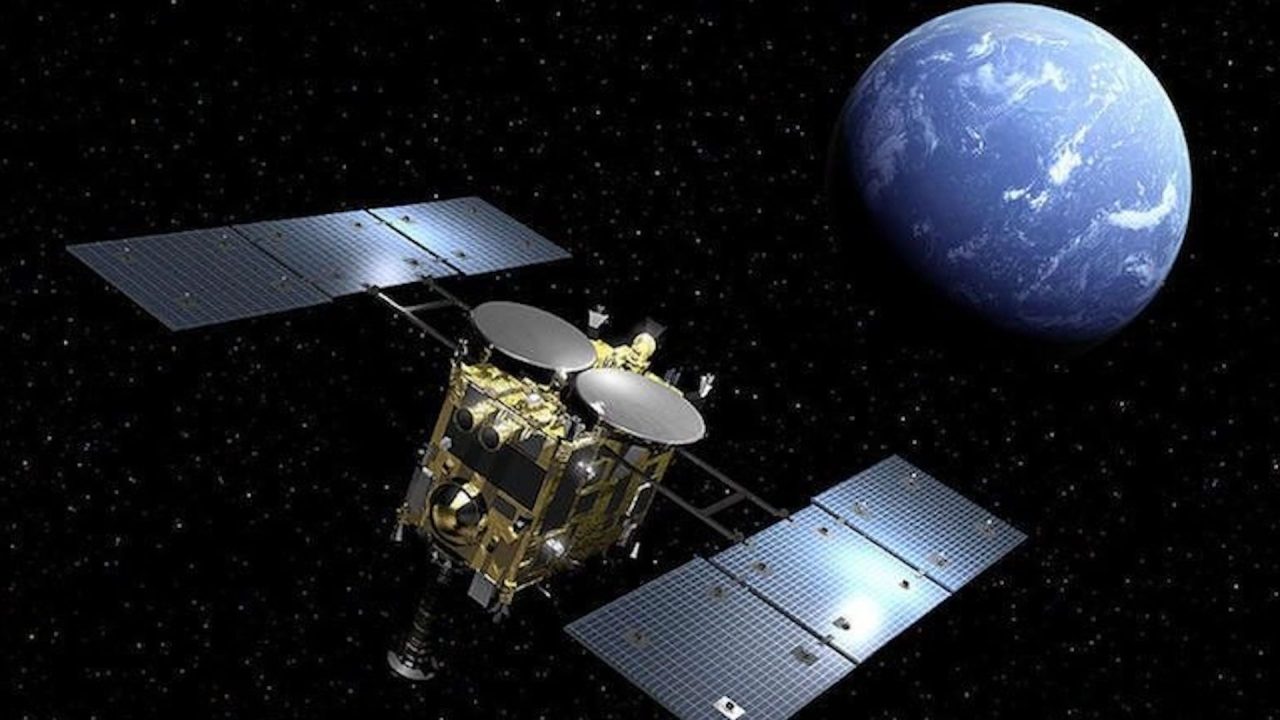
Japan Aerospace Exploration Agency (JAXA) officials have announced a significant modification to the extended mission of the Hayabusa2 probe, abandoning plans to land on a specific near-Earth asteroid due to technical difficulties with the spacecraft’s propulsion system.
The veteran probe, which launched in 2014 to collect samples from the asteroid Ryugu, successfully returned those samples to Earth in December 2020. Since then, it has been conducting an extended exploration phase, which included a close flyby of the double asteroid Torifune in July. However, recent issues have forced a change in strategy for the final act of the mission.
Initially, Hayabusa2 was scheduled to rendezvous with and land on the small, 11-meter (36-foot) wide near-Earth asteroid 1998 KY26 in 2031. This plan was scrapped after the spacecraft’s final functioning ion thruster, out of four total engines, malfunctioned in mid-August. Additionally, sensors detected unexpected erosion on the spacecraft’s surface during its long voyage.
“The deterioration of the onboard equipment … is becoming increasingly evident,” Yuya Mimasu, the team leader of the extended mission, told the Japan Times. The decision to alter the course was publicly announced at a JAXA press conference on Tuesday, November 17, following a Cabinet Office space policy subcommittee meeting.
Rather than targeting 1998 KY26, the spacecraft will now execute a high-speed flyby of a different tiny asteroid, designated 2015 BM510, in April 2028. No landing will be attempted on this new target. The asteroid 2015 BM510 is classified as a D-type asteroid, a classification that suggests it is organic-rich and comet-like, potentially originating from the outer solar system. It has previously been identified as a primary target for the European Space Agency’s mini-Fast mission proposal.
While the loss of the landing opportunity on KY26 is a setback, JAXA views the original Hayabusa2 mission as a major success. The new trajectory will coincide with the launch of JAXA’s next major asteroid mission, Destiny+. Scheduled to launch alongside ESA’s Ramses mission to study Apophis, Destiny+ will first fly by Apophis before its close approach to Earth in 2029, before proceeding to asteroid 3200 Phaethon, the source of the Geminid meteor showers.



Still amazing that we can reach these tiny rocks. The science gained from a flyby is valuable.
Engine erosion over such long missions is a real headache. Hope they have backup power sources.
Destiny+ will definitely pick up the slack here. The space race is getting really interesting lately.
So they are just flying past now? Feels anticlimactic compared to the original bold landing goal.
It is wild that this probe is still going after nearly a decade. What incredible engineering.
D-type asteroids are fascinating. I hope the flyby gives us enough data to understand their organic content.
Who knew an 11-meter asteroid would be so hard to land on? The flyby still seems impressive.
Disappointing that the engine failure killed the landing plan. JAXA still did great with Ryugu samples though.