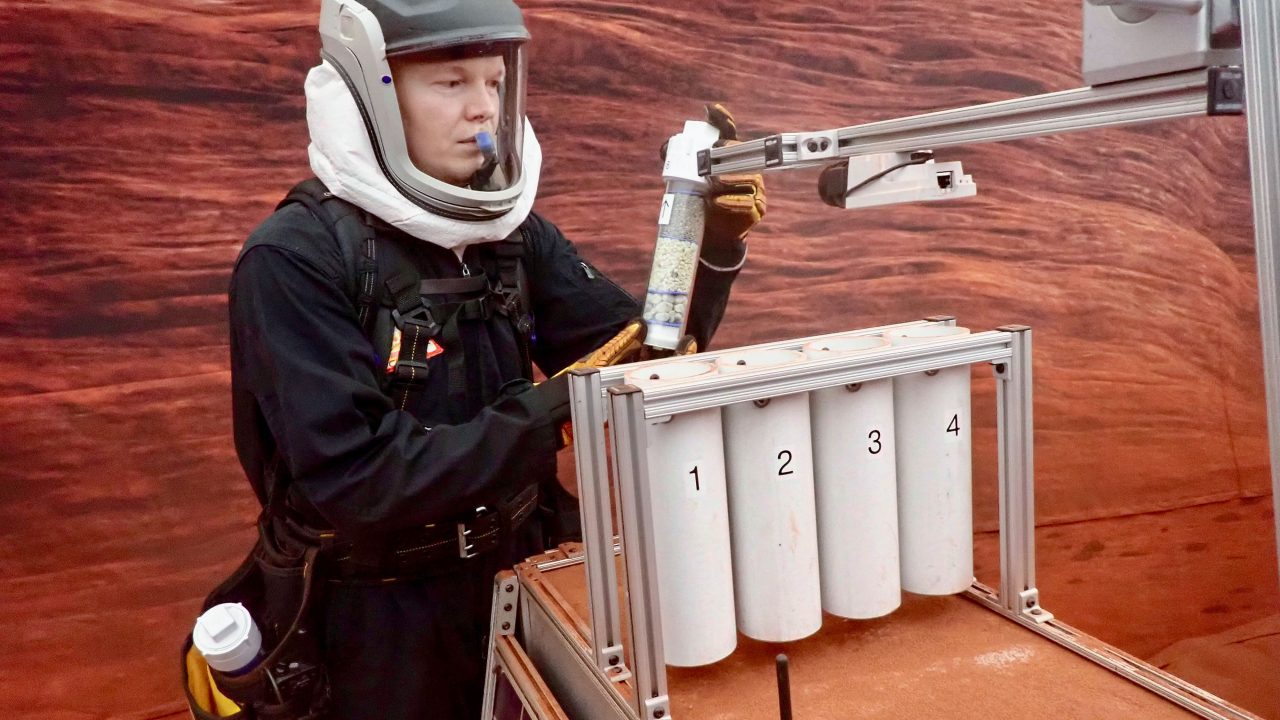
NASA has concluded its Crew Health and Performance Exploration Analog (CHAPEA) program, a 378-day simulation designed to mimic the conditions of a short Mars mission. The test, which ran from October 19, 2025, to October 31, 2026, placed four analog astronauts inside a 1,700-square-foot habitat located in a hangar at the Johnson Space Center in Houston. The enclosed facility featured four private sleeping quarters, a galley kitchen, exercise equipment, and a dedicated science area, replicating the confinement and workload expected of crew members traveling to and staying on the Red Planet.
A key focus of the simulation was the significant communication delay between Mars and Earth. Depending on orbital positions, signals between the two planets can take up to 23 minutes one way. This constraint affects everything from operational commands to personal messages, making data efficiency critical. “That will mean a[n extra] four-minute delay just because I sent a thumbs-up,” explained Ross Elder, the mission commander and an Air Force test pilot. The crew had to adopt concise communication methods to minimize round-trip time with mission control and family members on Earth.
The four-person crew consisted of Elder, U.S. Space Force officer Ellen Ellis, commercial airline pilot James Spicer, and electrical engineer Matthew Montgomery. During the nearly year-long confinement, the team performed daily experiments focused on water recycling, microbial DNA analysis, combustion science, and crop cultivation. They grew fresh produce, including tomatoes, peppers, and herbs, in an indoor nursery to supplement their diet, which otherwise resembled the preserved rations consumed on the International Space Station. The crew also conducted simulated spacesuit walks in a 1,200-square-foot outdoor area filled with red soil and virtual reality exercises on treadmills.
Sara Whiting, the CHAPEA project scientist, noted that the simulation included both scheduled tasks and unexpected emergencies, referred to as “injects,” to test equipment failure protocols and cognitive load. While the habitat provided luxuries such as hot showers and a media library for leisure, the environment was strictly regulated to mimic the constraints of a future Mars base. The crew had previously attended leadership training to strengthen interpersonal dynamics, recognizing that personality conflicts are likely in small, isolated groups over long periods.
The data collected from physiological, biomedical, and performance measures will help NASA plan future exploration campaigns, which are currently targeted for a six-month outbound journey, a brief surface stay, and a six-month return. Now back on Earth, all four CHAPEA participants are submitting applications for NASA’s latest astronaut candidate recruitment, which opened on November 7 and will close on December 3. “We’ve joked that you’ve got four crewmembers already who are ready to make the trip,” Elder said, indicating that the team is eager to transition from simulation to actual interplanetary travel.

Wait, they applied to be NASA astronauts? Feels like they should just get the spot immediately.
Growing peppers in a simulation habitat sounds like the ultimate stress test for anyone.