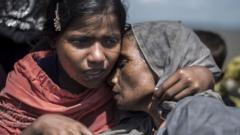
Myanmar faces a potential historical verdict from the International Court of Justice (ICJ) on Thursday as judges prepare to determine whether the country’s military actions against the Rohingya population constitute genocide. This case, filed by The Gambia in 2019, carries significant weight because no state has previously been found guilty of genocide by an international court, a landmark that lawyers say would bolster the 1948 Genocide Convention.
The legal battle stems from the mass expulsion of Rohingya from Rakhine State in August and September 2017, a military operation characterized by widespread brutality, including the burning of villages and mass rapes. While individual perpetrators from conflicts in Rwanda and the former Yugoslavia have been prosecuted for genocide, this ICJ case is novel in that it accuses the Myanmar state itself of the crime. The Gambia, supported by the Organisation of Islamic Co-operation, argued that all nations are bound by the Genocide Convention and have a legal interest in its enforcement.
Myanmar has consistently denied allegations of ethnic cleansing or genocide, maintaining that its “clearance operations” were a response to terrorist activities by Rohingya militants. In 2018, a UN fact-finding mission described the military’s tactics as “grossly disproportionate,” but Myanmar rejected the report. Because Myanmar is not a signatory to the International Criminal Court, the ICJ became the primary legal avenue for victims. The initial legal defense was led by Nobel laureate Aung San Suu Kyi, who was later deposed in the 2021 coup; the current military regime, headed by General Min Aung Hlaing, now manages the case.
Legal experts note that proving state-level genocide requires demonstrating a specific genocidal intent. The defense argues that while war crimes may have occurred, the evidence does not meet the high threshold for genocidal intent, citing the complexity of the conflict. Conversely, the prosecution presented evidence of decades of discriminatory laws, including the 1982 citizenship law, to establish a pattern of intent to destroy the Rohingya population.
If the court rules in favor of The Gambia, Myanmar would be officially designated as having committed a grave international crime, though the ICJ verdict carries no financial penalties or enforcement mechanisms. The ruling is expected to be symbolic rather than practical, particularly as General Min Aung Hlaing focuses on rebuilding relations with neighboring Asian nations rather than the West. For the Rohingya diaspora, however, the verdict represents a crucial moment of acknowledgment after decades of suffering. Over a million Rohingya remain in camps in Bangladesh, with hopes for repatriation complicated by ongoing conflict in Rakhine State and the destruction of their former homes.


Myanmar calling it ‘clearance operations’ against terrorists is just ridiculous spin. We all saw the UN report evidence.
A million people still stuck in camps. Acknowledgment is good, but it doesn’t feed anyone. Real help is missing.
Wait, is Aung San Suu Kyi involved still? Her deposal complicates things. Who exactly is representing them now?
The 1982 citizenship laws were clearly a long-term plan to erase them. It wasn’t just a sudden military crackdown.
Symbolic verdicts are nice, but without enforcement mechanisms, what’s the point? Myanmar simply won’t care about this ruling.
Finally. It feels like a small victory for truth, even if the ICJ lacks teeth. The world can’t just look away.