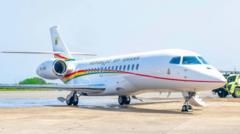
Ghana’s government has faced intense public backlash over the acquisition of a new French-made Falcon 6X presidential jet, which officials report cost approximately $61 million. The purchase, approved by parliament in December 2025, has been accused by opposition figures of representing misplaced priorities during a period when many citizens face high cost of living pressures and youth unemployment remains high. Despite the criticism, the administration insists the acquisition is justified by improved macroeconomic stability and the need to replace an aging aircraft.
The Dassault Aviation-manufactured jet was delivered to the Ghana Air Force on Monday, replacing the 16-year-old Falcon 900EX, which had suffered from recurring maintenance issues, including corrosion and fuel tank leaks, and had been grounded in France for several months in 2025. The new aircraft is noted for its extended flying range, which reduces the need for refueling stops on international trips. As part of a broader military aviation modernization program, the purchase also includes four Airbus helicopters.
Opposition MP Samuel Abu Jinapor, who serves in the opposition, criticized the governing National Democratic Congress (NDC) for what he described as hypocrisy, noting that party senior figures had previously opposed such purchases when in opposition. Jinapor emphasized that the expenditure is problematic given the current economic struggles of ordinary Ghanaians, stating, “What was unacceptable in opposition cannot suddenly become acceptable in government merely because the occupants of power have changed.” He has called for greater transparency regarding the procurement process and financing of the jet.
In response, the government argued that economic conditions have shifted significantly since the NDC previously opposed the purchase. Peter Lanchene Toobu, chairman of parliament’s defense committee, clarified that the party’s earlier opposition was based on timing rather than principle, citing the country’s need for a $3 billion IMF bailout at that time. Toobu asserted that the current strength of the Ghanaian currency and improved economic conditions make the purchase affordable without borrowing. Government spokesperson Kwakye Ofosu reinforced this view, pointing to falling prices of construction materials and lower borrowing costs as evidence of economic recovery.
The controversy also extended to the jet’s interior specifications. Amid claims that the aircraft featured luxury facilities such as a dedicated bedroom and bathroom, Ofosu dismissed these reports, stating, “There certainly is no bathroom. President Mahama has no intention of bathing in the air.” Officials explained that the jet is equipped with reclining seats that can be converted into sleeping arrangements, but denied the presence of dedicated hotel-style facilities.
Replacing a broken plane makes sense, but spending sixty million feels excessive when youth unemployment is still so high.
The comment about bathing in the air is hilarious. I just need them to explain how they financed it without borrowing.
Is it really that bad if the economy is actually stabilizing? Sometimes big purchases signal recovery to investors abroad.
I am shocked by the lack of transparency here. Why does it take a crisis for the public to demand accountability?
Focusing on jets while people struggle to afford basic food is truly embarrassing. Where is the priority for actual infrastructure?