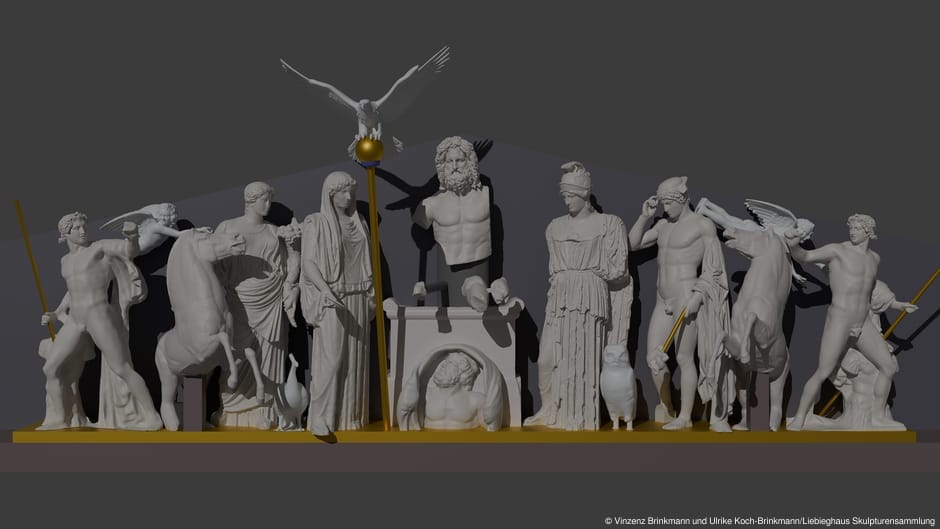
Researchers led by archaeologist Vinzenz Brinkmann have successfully reassembled the surviving fragments of the Parthenon’s eastern pediment, a masterpiece of High Classical Greek art that was destroyed during the Christianization of Greece. The breakthrough, announced after decades of investigation, relies on a combination of modern digital technology and a crucial historical clue provided by Roman artifacts.
The eastern pediment, located above the temple’s entrance, depicts the birth of the goddess Athena from the head of Zeus and was originally adorned with 39 figures spanning a length of approximately 29 meters. At its center stood a colossal statue of Zeus, standing 3.8 meters tall. For centuries, scholars struggled to determine the correct arrangement of the figures because only about 20% of the original marble volume has survived, with fragments scattered across museums in Athens, London, and other European cities.
The key to the solution emerged in 2014 when Brinkmann visited the Hermitage Museum in St. Petersburg. There, he identified a Roman sarcophagus featuring a relief of Athena’s birth that matched the missing pieces of the pediment. Realizing that nine similar sarcophagi, mostly located in Rome, depicted different sections of the Parthenon sculpture, the team used these reliefs as a reference point. By employing an iPhone to scan approximately 60 original fragments and utilizing 3D printing technology, Brinkmann and his wife, Ulrike Koch-Brinkmann, were able to digitally fit the pieces together with high precision.
“We’re very, very confident that we’ve solved the mystery,” Brinkmann stated, noting that the digital reconstruction allowed the team to identify Roman copies that corresponded exactly to the original marble shards. The findings are currently on display at the Liebieghaus sculpture collection in Frankfurt in an exhibition titled “Athena, the Stage is Yours: The Parthenon Puzzle,” which features a four-meter-long 3D model of the complete composition at a 1:7.7 scale.
While the exhibition was intended to include loans from major institutions such as the Vatican Museums and the Louvre, participation from Greece and the British Museum has been complicated by ongoing disputes over the ownership of Parthenon sculptures. Greece withdrew its planned loan after learning that the British Museum intended to contribute fragments, leading the Liebieghaus to also exclude the British-held pieces from the display.



Nice exhibition title. Seeing the 1:7.7 scale model sounds like a great way to understand the composition.
Zeus at 3.8 meters sounds massive. The scale of High Classical art still blows my mind today.
Hilarious that Greece pulled out because the British were invited. Typical drama with Parthenon ownership.
Solved in 250 years. Imagine the debates in the 18th century when this was just guesswork.
Great work, but can we actually display the full assembly? Or just the 3D model? Curious about the logistics.
Wait, Roman sarcophagi helped? That’s a clever twist. I never thought about that connection until now.
I hope the British Museum stops playing politics. Art belongs to the world, not just one country’s agenda.
Using an iPhone for high-precision archaeological reconstruction is fascinating. Tech really bridges the gap between ancient and modern.