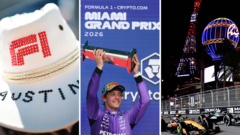
As Formula 1 continues to expand its presence in the United States, fans and industry insiders are drawing comparisons between the three domestic races: Las Vegas, Miami, and Austin. Each venue offers a distinct experience, ranging from the sensory spectacle of the Las Vegas Strip to the community-driven atmosphere of Texas and the high-energy lifestyle of South Florida.
Cadence Kim, a Dallas-based fan and member of the ATX GP Club, highlights how the presence of three US races has transformed F1 from a niche broadcast sport into a tangible, week-long community event. For Kim, the races serve as gathering points for fans to engage with the sport, attend meet-and-greets, and socialize. She notes that while Las Vegas functions as a high-energy party with hotel activations, Austin offers a more relaxed vibe with access to local Texas barbecue, and Miami requires preparation for extreme heat and extensive walking.
Justin Bell, a Vegas-based podcast host and Le Mans driver, argues that Las Vegas aligns perfectly with F1’s global entertainment ambitions. Although the event faces challenges such as late-night timings and cold desert evenings, Bell points to its economic success. The Las Vegas Grand Prix has generated an estimated $3.2 billion in economic impact for the Southern Nevada region over the past three years. Local visitors outside of Las Vegas have spent an average of $2,400 on non-racing activities per trip, according to figures from the 2024 race. Despite initial concerns about disruption, Bell believes the event’s popularity outweighs the drawbacks for the local economy.
The discussion also touches on the role of American representation in the sport. With Logan Sargeant being the last American to compete in a recent grand prix, attention is turning to rising talents like Jak Crawford, Colton Herta, and Ugo Ugochukwu. Crawford, an Aston Martin reserve driver, noted that he has inspired younger kart drivers to pursue F1 over traditional series like NASCAR and IndyCar. However, Bell suggests that for the American market, a driver must be a media presence as well as a racer to significantly boost engagement, though Kim and others argue that the sport’s global nature allows fans to support international drivers regardless of nationality.
Harry Benjamin, an F1 commentator, offers a mixed perspective on Las Vegas, describing it as a ‘Marmite’ destination that evokes strong reactions. While acknowledging the spectacle of cars racing past iconic landmarks under the lights, he notes that the sensory overload and expense can be exhausting. In contrast, he finds Miami stressful due to traffic and heat, while Austin remains a favorite for its purpose-built track design that allows for easy spectating from various angles. Benjamin concludes that while Miami has a vibrant aesthetic, Austin retains the ‘soul’ of American Formula 1, whereas Las Vegas remains a unique, albeit polarizing, spectacle.

The expense in Vegas is ridiculous. A single hotel room costs more than my monthly car payment.
Sargeant is gone, but Herta and Ugo are stepping up nicely. F1 has a real future here.
Can we just admit Texas barbecue makes the Austin weekend better? The food scene is top tier.
I love the ‘Marmite’ description for Vegas. It really is that kind of love-it-or-hate-it situation.
Las Vegas at night sounds terrifying for drivers. I hope the visibility is better than it looks.
It is wild to see American drivers like Crawford inspiring kids to switch from NASCAR. Huge cultural shift.
Miami is brutal. I need ten layers of sunscreen just to exist there. F1 needs to rethink the heat policies.
Vegas is pure chaos, but that $3.2 billion figure is crazy. Does it actually help local workers long term?
Austin definitely feels more authentic. The COTA layout actually lets you see the action without breaking the bank.