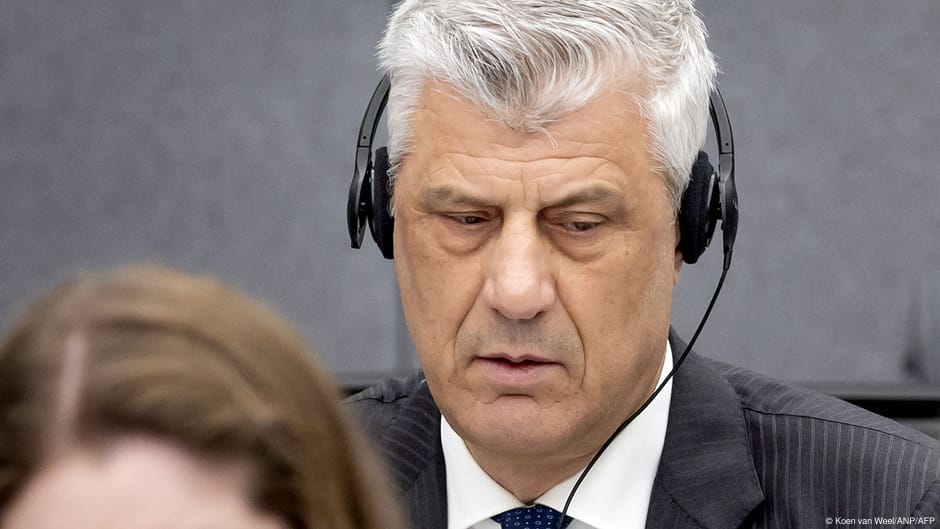
Hashim Thaci, the former president of Kosovo and political leader of the Kosovo Liberation Army (KLA) during the 1998-1999 war, was convicted on Tuesday by a court in The Hague of attempting to influence witnesses in his war crimes trial. The judge sentenced Thaci to 17 months in prison, a term that will be added to the 25-year sentence for war crimes handed down by the same court on September 16.
The conviction relates to the Specialist Prosecutor’s Office’s indictment, which alleged that Thaci provided confidential information about witnesses to visitors at the detention facility and instructed them on how to influence their testimony. Three other men were also convicted in the case: Bashkim Smakaj, former head of the Kosovo Intelligence Agency; Hajredin Kuci, former Minister of Justice; and Fadil Fazliu.
Thaci, who stepped down as president nearly six years ago to defend himself against international charges, is considered a hero by many in Kosovo. His initial conviction in September sparked anger and dismay, with demonstrators clashing with police in Pristina. He has vowed to appeal the war crimes conviction.
The Kosovo government responded swiftly to the latest ruling, emphasizing its commitment to the rule of law and fair judicial processes. Prime Minister Albin Kurti stated that the government views the first-instance judgment as unjust and is working to secure a correction at the appeals level. A working group chaired by Foreign Minister Glauk Konjufca has been established to draft a strategy for the appeals proceedings.
The Kosovo Specialist Chambers, located in The Hague for security reasons, was established in 2015 by the Kosovo parliament at the instigation of the European Union and the United States. It was created to investigate serious crimes allegedly committed by KLA members. The Kosovo parliament is currently considering amendments to the law governing the court, with a draft expected to be adopted that would narrow the court’s mandate in several areas.


Influencing witnesses is a serious breach. No amount of political hero status excuses that behavior.
The EU and US really built this complex system just to watch these old cases drag on.
Those protests in Pristina back then showed just how much he is still adored there.
It is a relief to see the courts actually enforcing the obstruction charges without caving to pressure.
Kurti calling the ruling unjust right after the trial is a complete double standard.
Does the new sentence run concurrently or consecutively? The article says added, but I am confused.
I am genuinely surprised he was caught leaking confidential witness info from inside the detention facility.
Adding 17 months on top of 25 years feels like they are just stacking punishments endlessly.