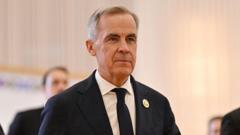
Canadian Prime Minister Mark Carney is turning to China as a potential strategic partner for the nation’s embattled automotive sector, a move that has sparked significant controversy within the Trump administration. Speaking from Cambodia during the Asia-Pacific Economic Cooperation (APEC) summit, Carney indicated that if a trade deal with the United States cannot be finalized, Canada may look to European and Asian manufacturers to sustain its auto manufacturing jobs.
The shift in strategy comes as US tariffs on Canadian-made vehicles have resulted in thousands of job losses in Canada. Approximately 90% of cars produced in Canada are exported to and sold in the US market, making the sector highly vulnerable to cross-border trade disputes. Carney met with Chinese President Xi Jinping in China on Tuesday for their second meeting in under a year, where the leaders discussed enhancing relations and agreed to further tariff reductions, though vehicles were not explicitly mentioned in the joint statements.
Earlier this year, Canada announced it would allow 49,000 Chinese electric vehicles (EVs) to enter the country at a low tariff rate, with plans to gradually increase that quota to 70,000 by 2030. This policy marks a significant departure from the US approach, which imposes heavy tariffs on Chinese EVs to protect domestic manufacturing. Carney suggested in January that opening the door to Chinese EVs could stimulate investment in Canadian companies and create new manufacturing jobs.
The US response has been swift and critical. Peter Navarro, a senior counsel for trade and manufacturing to President Donald Trump, warned Carney against leveraging China against the US. In a post on X, Navarro wrote, “Are u really threatening to play China off the US? This is offensive in the extreme,” adding that Canada should worry about China “eating Canada alive.” His comments were reposted by Pete Hoekstra, the US ambassador to Canada.
Meanwhile, Canadian Minister of International Trade Maninder Sidhu visited a plant operated by Chinese manufacturer Chery earlier this month. Sidhu stated that Canadians could expect affordable Chinese EVs to be available in the market by early 2027. Speculation has also grown that the Brampton, Ontario assembly plant, recently put up for sale by Stellantis after becoming idle due to tariff-related retooling delays, could be leased back to assemble “affordable” EVs, potentially involving Chinese manufacturers.
Ontario Premier Doug Ford has opposed this prospect, warning in a letter to Carney against allowing Chinese EV kits to be assembled at the Brampton facility. Experts, including Lynette Ong from the University of Toronto’s China Governance Lab, note that introducing Chinese auto manufacturing in Canada is controversial due to fears of job losses and erosion of the North American industry. However, Carney has emphasized that “clear guardrails” exist, such as restrictions on sensitive technologies like artificial intelligence and critical minerals. As US-Canada trade negotiations continue with some progress but persistent differences, the extent of Canada’s embrace of Chinese manufacturing remains contingent on the outcome of those talks.
This is all very confusing. One minute we are allies, the next we are competitors. Just let us know where we stand.
Doug Ford is right to worry. We do not want foreign tech controlling our core infrastructure and data systems.
Honestly, the US is forcing this. Why should Canada stick to a trade partner that just slashed our income?
Cheap Chinese cars sound great for buyers, but what happens to the skilled workers who build American cars now?
Navarro’s threat about China eating us alive is dramatic, but I get the point. It is a very risky geopolitical move.
Does anyone actually know if the Brampton plant is really going to Chinese manufacturers? That feels like pure speculation right now.
I am surprised he would pivot so quickly. Maybe the tariffs were just too painful to ignore for much longer.
Carney is taking a real gamble here. Betraying the US might save some jobs, but it could isolate us entirely.