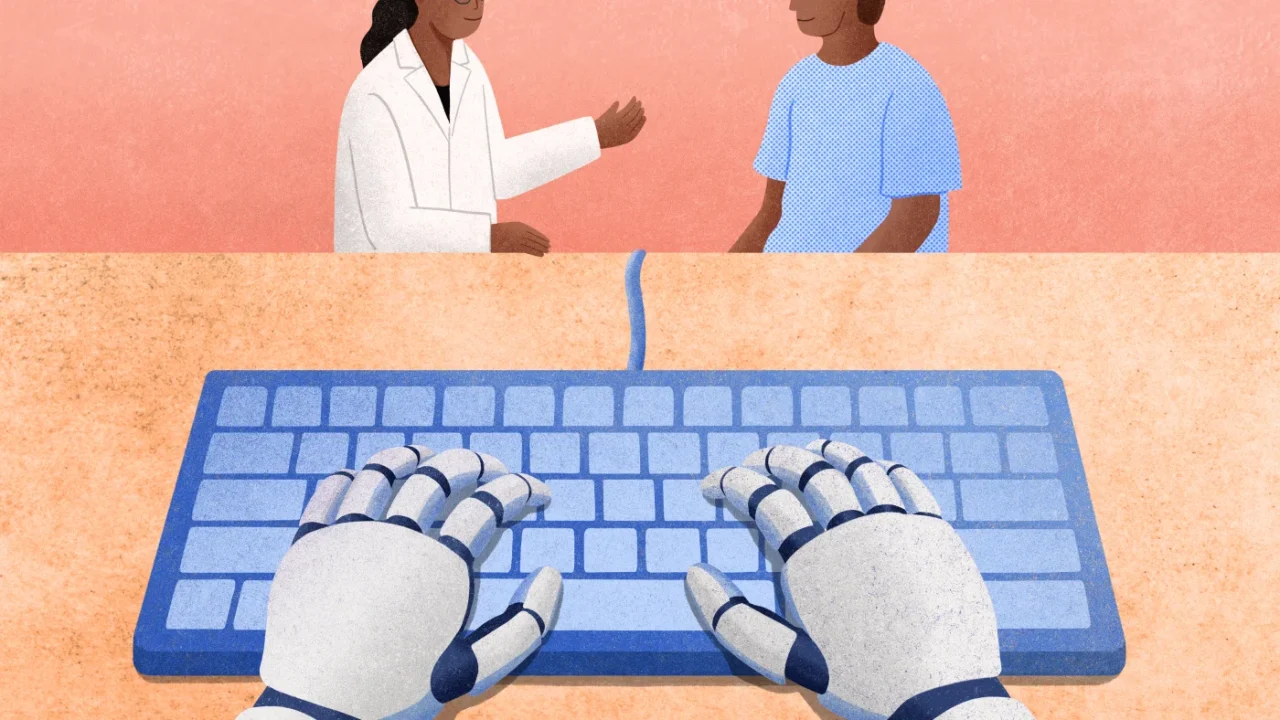
Artificial intelligence scribes are rapidly becoming a standard tool in medical practices, from emergency rooms to primary care offices. While these tools offer significant time-saving benefits and allow physicians to maintain better eye contact with patients, they also introduce complex questions regarding data privacy, accuracy, and health equity.
Dr. Mara Gordon, a family physician in Camden, New Jersey, who answers reader health questions for NPR, is an eager adopter of the technology. She uses a smartphone app that records conversations and employs artificial intelligence to generate preliminary medical summaries. “It saves me time, but more importantly, I like using it because it helps me focus more fully on my patient,” Gordon said. “When I use the AI scribe, I don’t have to talk and take notes at the same time – I can actually make eye contact with my patient rather than staring at the computer screen.”
The technology operates by using automatic speech recognition to record and transcribe conversations, distinguishing between the doctor’s and patient’s voices. Once the visit concludes, a large language model geared toward medical applications converts the transcript into a standardized clinical note. These recordings are typically uploaded to HIPAA-compliant clouds, encrypted for security, and deleted after a set period to protect patient privacy.
However, Gordon acknowledges that AI scribes are not infallible. In one instance, the software failed to capture the nuance of a conversation with a patient who did not accept his metastatic cancer diagnosis, incorrectly noting that the patient had been misdiagnosed. Dr. Eileen Kim, an assistant professor of internal medicine at the University of California San Diego, warned that when overburdened doctors rely on AI notes without adequate review, errors can propagate throughout electronic health records. “You have a doctor who’s overburdened… They have this AI tool that’s offered to them that seems like a great solution, but they don’t have time to adequately review everything,” Kim said.
Health equity advocates also raise concerns, noting that many current scribe systems are limited to English-speaking patients, which could exacerbate existing disparities in healthcare access. Furthermore, patients have the right to opt out of AI scribing, though broader integration of AI in billing and risk calculators makes it difficult to completely separate the technology from patient care. Gordon emphasized that despite the assistance of robots in administrative tasks, she remains responsible for the content of the notes and takes pride in being a “human doctor with human intelligence.”
Gordon’s point about being a ‘human doctor with human intelligence’ really resonated with me today.
If doctors are too busy to review the AI notes, errors just spread faster throughout the system.
It feels like a double-edged sword. Efficient, yes, but I worry about losing that human touch in care.
The cancer diagnosis error mentioned is terrifying. A machine should never guess emotional nuance in a medical note.
I am skeptical about the privacy claims. Who really controls my health data in those encrypted clouds?
What happens when the AI misinterprets a non-English speaking patient? This creates a real equity gap.
Finally, doctors can actually look at you instead of the computer. That eye contact makes a huge difference.