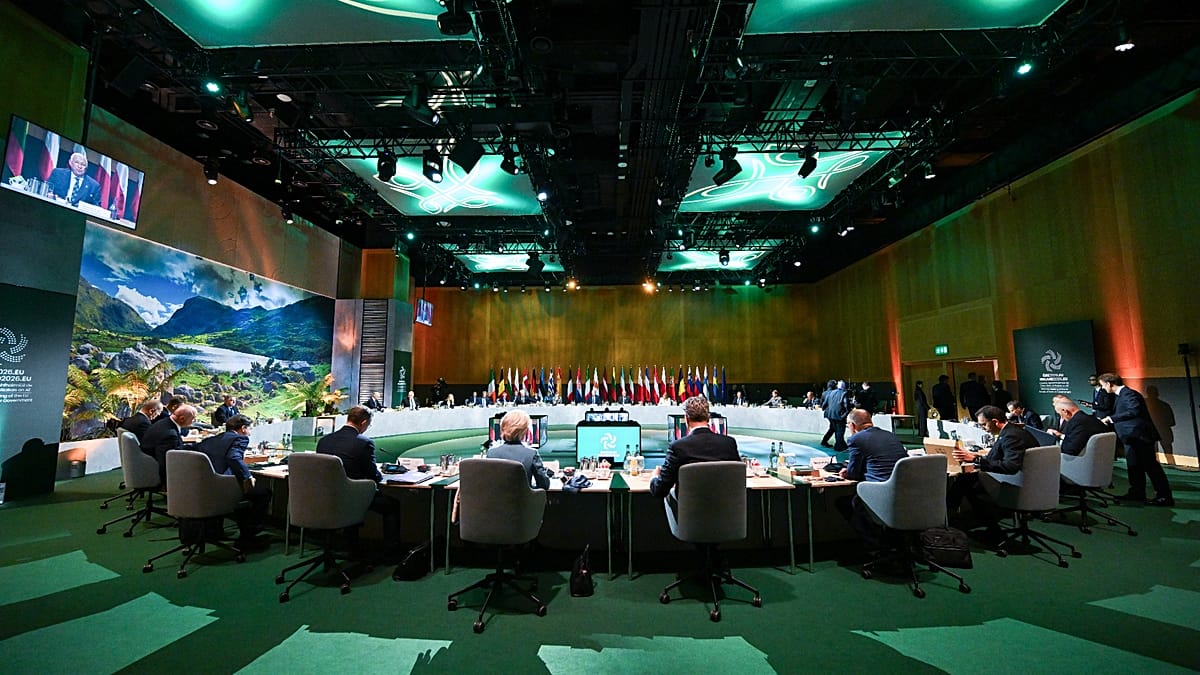
European foreign affairs ministers convened in Brussels on Monday, focusing on sustained support for Ukraine and the continent’s evolving relationship with the Middle East. The formal agenda is expected to be overshadowed by intense diplomatic efforts following the recent informal European Council summit in Dublin. There, EU leaders agreed on a unified representation strategy for peace negotiations involving the United States, Ukraine, and Russia.
The agreed team will comprise representatives from France, Germany, the United Kingdom, Italy, Poland, the European Union institutions, and NATO. This structure addresses the deadline set by Ukrainian President Volodymyr Zelenskyy for determining Europe’s role in the talks. Swedish Foreign Minister Maria Malmer Strömberg, speaking after her own engagements in Abu Dhabi, emphasized that the recent prisoner exchange agreement was not a substantive breakthrough. She stated that Russia remains uninterested in peace and called for the EU to focus on filling the 2027 budgetary gap and restarting discussions on utilizing Russia’s frozen assets.
Latvian Prime Minister Andris Kulbergs warned that the debate over who should lead European delegations risks falling into a trap set by Russian President Vladimir Putin. Kulbergs argued that the diversionary tactics aim to obscure the reality of the ongoing invasion, urging Europe to prioritize practical support for Ukraine’s security and survival over stylistic questions of representation.
Concerns regarding European security were heightened by an alleged sabotage attempt against Estonian defense company Threod Systems, which Estonian authorities attribute to the Russian GRU military intelligence service. In response, Estonia plans to close its road border crossings with Russia starting December 1. Estonian Foreign Minister Margus Tsahkna asserted that Europe must not allow Putin to achieve through negotiation what he has failed to accomplish on the battlefield.
Looking ahead, the European Commission is scheduled to present a proposal on Wednesday for a €45 billion support loan for Ukraine. This amount covers two-thirds of the country’s projected €70 billion shortfall for the next year, with the EU budget providing the guarantee. While the proposal supports all 27 member states, countries including Slovakia, Hungary, the Czech Republic, and Bulgaria have expressed intent to opt out of the common borrowing mechanism. Slovak Prime Minister Robert Fico reiterated his opposition to war-related loans, stating a preference for peace over military financing.
Additionally, the Commission will begin consultations on Tuesday to refine the 22nd package of sanctions against Russia, targeting the banking sector, cryptocurrency, and shadow fleets. Officials aim for a smooth adoption process without vetoes, while also addressing Middle Eastern issues, including recent French claims regarding Iranian cyber attacks on European infrastructure and strategies for supporting Syria’s political transition.

I worry that arguing about who leads the delegation is just letting Putin set the agenda again.
It feels ironic that we are borrowing billions for war while some countries refuse to even participate.