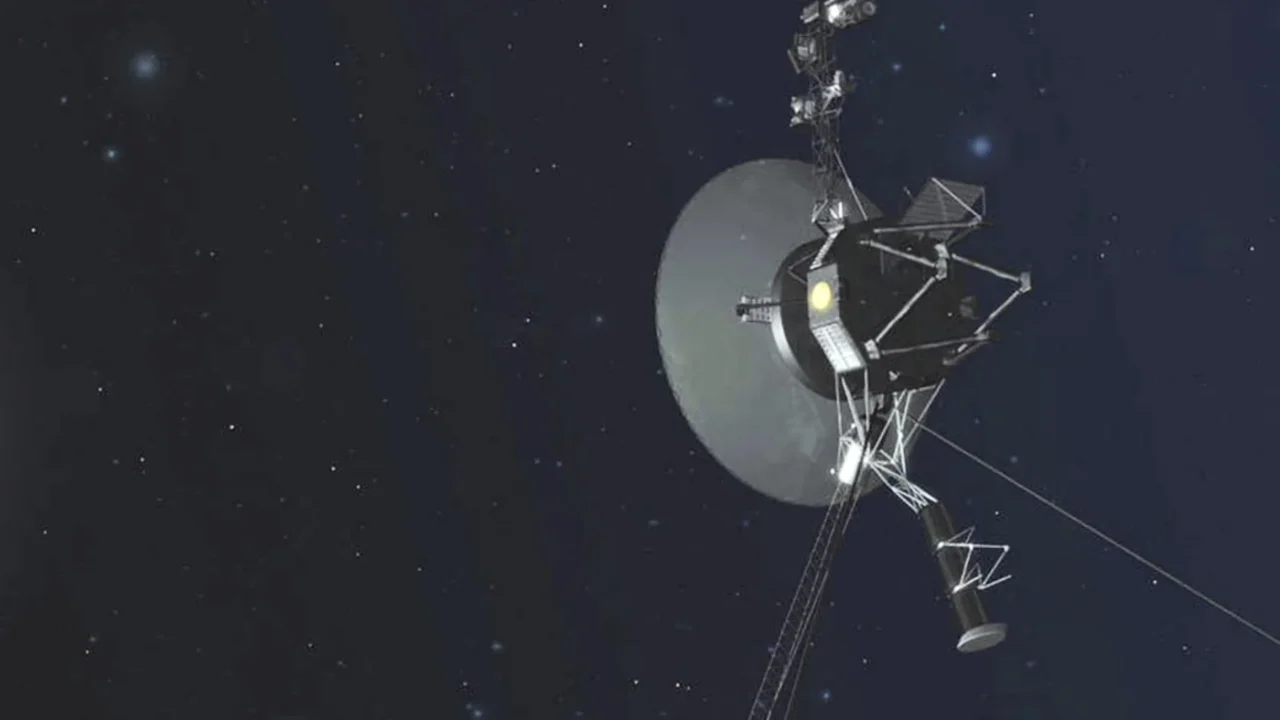
NASA’s Voyager 1 spacecraft has reached a new distance milestone, becoming the most remote human-made object ever launched into space. The probe crossed the threshold of 16 billion miles from Earth, marking a journey of nearly 50 years since its launch on September 5, 1977. This specific distance corresponds to one light-day, the distance light travels in 24 hours, which Voyager 1 is estimated to have reached at 5:16 a.m. ET on Wednesday.
To commemorate this symbolic achievement, NASA has invited the public to participate in the “Shine Bright for Voyager’s Light-Day” event. On Tuesday night, individuals are encouraged to transmit the spacecraft’s call sign, V-G-R, into the sky using flashlights or mobile phone lights in Morse code. The sequence consists of three quick flashes and one long flash for ‘V’, two long flashes and one quick flash for ‘G’, and one quick, one long, and one quick flash for ‘R’.
Voyager 1 has been the most distant object sent by humans since February 17, 1998, when it overtook the earlier probe Pioneer 10. It is one of only two spacecraft, alongside its twin Voyager 2, to operate outside the heliosphere, the protective magnetic shield of the solar system. Upon reaching the interstellar boundary in 2012, the mission shifted to charting magnetic fields, particles, and plasma waves in the interstellar medium.
The spacecraft’s early mission included significant discoveries, such as identifying a faint ring system around Jupiter in 1979 and capturing detailed imagery of Saturn’s rings and moons in 1980. To conserve power and extend its operational lifespan, NASA earlier this year deactivated the Low-energy Charged Particles experiment. The probe currently retains two functioning science instruments: one for measuring magnetic fields and another for detecting plasma waves.
Despite its vast distance, Voyager 1 continues to carry the Golden Record, an interstellar time capsule intended to convey a message to extraterrestrial life. The gold-plated disc contains 115 images, natural sounds like wind and surf, greetings in 35 languages, and instructions on how to play the record, symbolizing the story of Earth and its inhabitants.


We should be humbled by how far our technology has pushed into the unknown dark void.
They had to turn off some experiments to save power. It is surprisingly durable for its age, honestly.
Wait, it took light twenty-four hours to get that far? Mind is officially blown by the scale of this.
I love that it still carries the Golden Record. A nice reminder of what we are all about.
Does it still have enough power to keep sending data back to us for another decade?
Morse code with flashlights? That seems like a very 1990s way to celebrate a milestone from the 21st century.
Fifty years out there! It is wild to think this little probe is farther than any other human-made object ever.