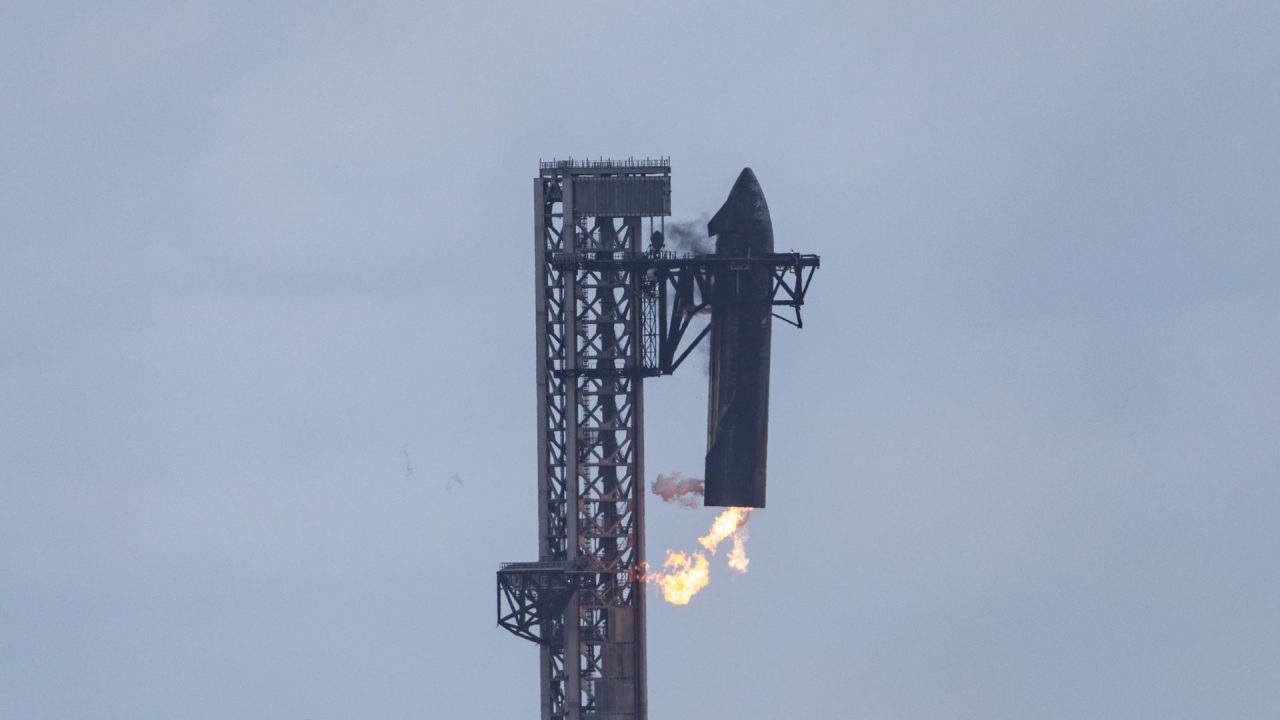
SpaceX has made significant strides in its Starship development program following the 15th test flight of its megarocket. Launched on Friday, November 13, the mission aimed to achieve a simultaneous recovery of both the Super Heavy booster and the Ship upper stage at the company’s Starbase facility in Texas. While the Super Heavy booster encountered a low-fuel alarm and diverted to a splashdown in the Gulf of Mexico, the Ship upper stage successfully returned to Earth. It was caught by the launch tower’s ‘chopsticks’ arms on Saturday afternoon, November 14, marking the first time the company has recovered the upper stage in such a manner.
The achievement is considered a major milestone because catching the Ship upper stage is significantly more difficult than retrieving the booster, as the upper stage operates at much higher altitudes and velocities. During a live webcast, SpaceX spokesperson Dan Huot described the event as reaching the “holy grail of spaceflight,” noting that the successful catch changes the trajectory for the program. This recovery strategy is designed to allow for rapid inspection, refurbishment, and reflight of the vehicles, which is essential for the launch cadence targeted by CEO Elon Musk. Musk has previously stated that SpaceX aims to conduct 10,000 Starship launches per year by 2030, a rate that would require launching a vehicle roughly every hour.
The high-frequency launch plan is intended to support the deployment of massive satellite constellations, including the next-generation Starlink V3 network, which is planned to consist of 100,000 satellites, and the Starmind AI data-center constellation, which could feature one million spacecraft. By comparison, the current Starlink network in low Earth orbit comprises approximately 11,000 satellites. While SpaceX has reflown the Super Heavy booster on previous occasions, with several months separating each reflight, the company has not yet demonstrated rapid reflight for either component, a capability that must be proven to meet future operational goals.
Looking toward deep-space exploration, NASA has selected the Starship upper stage as the first crewed lunar lander for its Artemis program, with the goal of establishing a base near the lunar south pole by 2032. The Starship is scheduled to land astronauts on the Moon for the first time during the Artemis IV mission, targeted for 2028. To make this possible, SpaceX is currently installing a crew cabin and life-support systems, with progress reported to be on track. A significant technical hurdle remains, however: Starship will require orbital refueling at a space-based depot for deep-space missions. Since the rocket cannot launch with full fuel tanks due to weight constraints, it must be resupplied in orbit by tanker versions of the Ship. The number of refueling visits required is uncertain, with estimates ranging from six to 22. Successfully demonstrating off-Earth propellant transfer, which involves maintaining extremely cold liquid oxygen and liquid methane, is a critical next step. If SpaceX cannot meet the Artemis IV deadline, NASA may rely on alternative private landers, such as Blue Origin’s Blue Moon.



Finally! We’ve been waiting ages for them to successfully grab the Ship with the chopsticks.
The Starlink V3 constellation sounds incredible, but I wonder if we have regulations for that many satellites in orbit.
Blue Origin better start sweating now. If SpaceX nails this timeline, their Blue Moon plans might be obsolete.
Still worried about the orbital refueling complexity. Six to twenty-two tankers is a massive engineering unknown.
Nice recovery despite the booster issue. That ‘holy grail’ quote from Dan Huot really sold me on the progress.
The 10,000 launches per year target feels wildly optimistic. Does the infrastructure actually exist to support that cadence?
Catching the upper stage is a huge step forward for rapid reflight capabilities and future Mars missions.