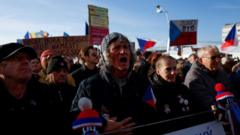
Prague has become the site of a significant civic demonstration as thousands of residents gathered to oppose a proposed shift in how public broadcasters are financed. The crowd, which organizers estimate included roughly 400,000 people in Letna Park, is described as the largest protest in the independent Czech Republic since 1993. The rally was coordinated by the Million Moments for Democracy association to push back against legislation that would eliminate the household license fee in favor of direct state budget allocations.
The coalition government, composed of the populist ANO party and two right-wing Eurosceptic parties, introduced the bill to reduce broadcaster costs, insisting that editorial independence will remain intact. However, critics argue that the measure mirrors media control strategies previously employed in Hungary under former Prime Minister Viktor Orbán, and they contend the change would allow politicians to suppress free media.
Currently, Czech households pay a monthly fee of 205 crowns ($9.44) to support Czech TV and Czech Radio. Despite the government’s assurances, the proposal passed its initial draft stage in parliament last month, prompting widespread public opposition. Some attendees at the protest wore hats made from folded newspapers as a tribute to the animated character Večerníček, a staple of the broadcaster’s children’s programming.
Premier Andrej Babis, who took office in December 2025, faces mounting criticism over the coalition’s perceived hostility toward journalism. Pavol Szalai, director of the Prague bureau for Reporters Without Borders, stated in June that political pressure on both private and public media outlets has become a defining feature of Babis’s leadership.
Doesn’t a monthly fee seem cheaper than the political headache? Why would they switch budgets if they care about viewers?
The government keeps saying everything is fine, but anyone paying attention knows exactly how this Hungarian-style playbook ends for independent press.
400,000 people? That is genuinely shocking. I never thought media funding would spark such massive civic engagement in Central Europe.
The newspaper hats were such a creative touch. It felt very nostalgic and showed real support for the kids’ shows.