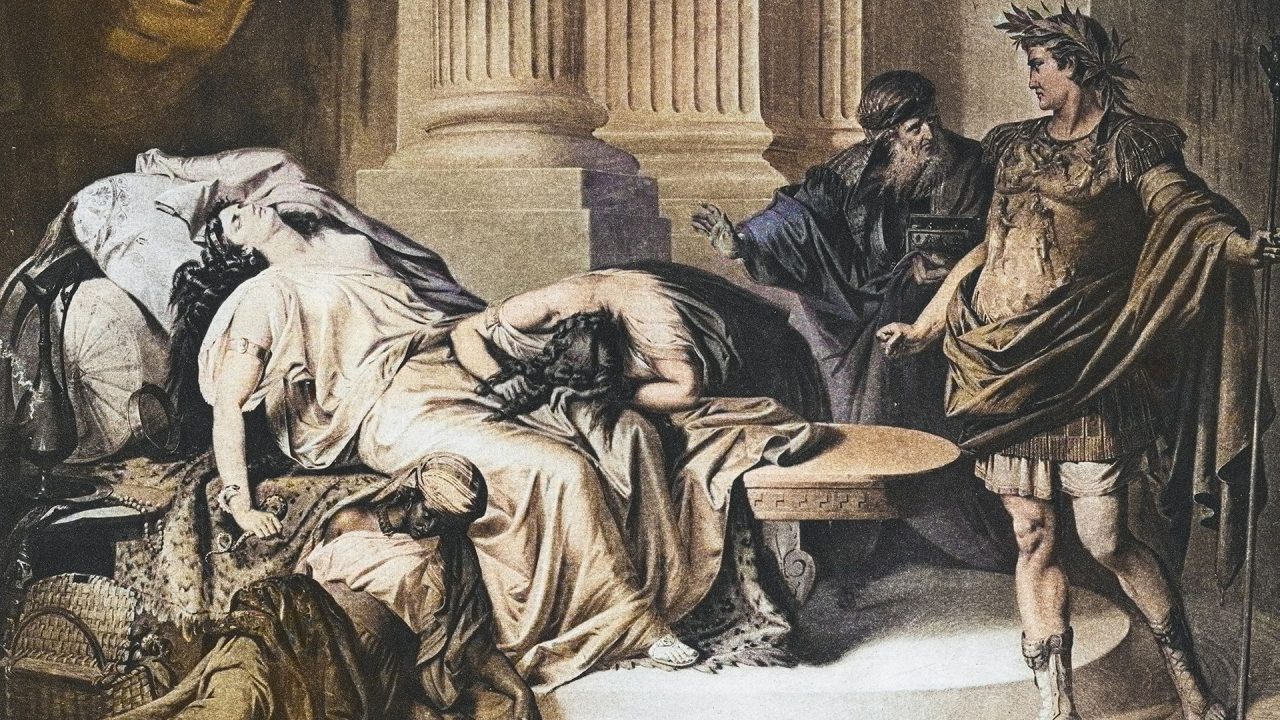
The death of Egyptian queen Cleopatra remains one of history’s enduring mysteries, with modern scholars largely rejecting the traditional account of a fatal snake bite in favor of other methods of suicide. Following the defeat of Cleopatra and her Roman ally Mark Antony by Octavian’s forces at the Battle of Actium in 31 B.C., the queen was captured in Alexandria. While ancient texts such as those by Octavian and the historian Velleius Paterculus claim she died from the venom of an asp, many contemporary experts view this narrative as potential Roman propaganda designed to legitimize Octavian’s rise to power.
According to Prudence Jones, a professor of classics at Montclair State University, there is no definitive physical evidence to support the snake bite theory. Jones noted that much of Alexandria’s royal quarter is now underwater, and excavations led by underwater archaeologist Franck Goddio have yet to uncover Cleopatra’s mausoleum. Even if her remains were found, forensic analysis would likely fail to detect historical snake venom. Furthermore, Olympus, Cleopatra’s personal physician who might have provided a reliable account, left no surviving records of her death.
Surviving historical accounts, many written by Cleopatra’s enemies, offer conflicting details. Jane Draycott, a historian at the University of Glasgow, highlighted a poem by the Roman poet Horace, which depicted the queen handling serpents but also expressed grudging admiration for her refusal to be paraded as a trophy in Rome. Draycott argues that Cleopatra’s prior suicide attempts, including self-stabbing and starvation, indicate a strong desire to avoid captivity. In the Greco-Roman context, suicide was a way to maintain dignity and erase disgrace, unlike later Christian views.
After Mark Antony died by suicide following false reports of Cleopatra’s death, she reportedly sent a sealed letter to Octavian requesting to be buried beside him, signaling her intent to end her life. Roman historian Cassius Dio described faint pricks on her arm as the sole clue, but experts argue this is inconclusive. Jones explained that cobra bites can present as double puncture wounds, but not all such wounds are caused by snakes, and some bites deliver no venom at all. Draycott suggested that snake-shaped jewelry, which was fashionable in Alexandria, may have been mistaken for a real snake by Roman observers viewing effigies of the queen.
The prevailing view among historians is that Cleopatra used a fast-acting poison that did not cause visible distress such as seizures or vomiting, a detail inconsistent with the agonizing death caused by an Egyptian cobra’s venom. As the capital of the Mediterranean’s scientific research, Alexandria had access to pharmacological knowledge, and Cleopatra likely experimented with lethal substances. While Roman stereotypes often attributed secretive poisoning to women, scholars like Draycott caution against accepting these accounts without considering cultural bias. Ultimately, while the specific method of death may remain unknown, experts agree that Cleopatra chose to die on her own terms rather than face the humiliation of defeat.
So basically, she beat Octavian at his own game? Clever queen, no matter how she died.
Her desire to maintain dignity is the most important takeaway here, regardless of the specific method used.
I still find the cobra story more dramatic and fitting, even if it is likely inaccurate.
It is frustrating that her mausoleum is underwater. We will probably never get a real forensic answer.
Wait, snake jewelry could have caused the confusion? That is a surprisingly practical and interesting explanation.
I never realized how much of this was just propaganda from Octavian. History is so messy sometimes.
Finally, someone is challenging the snake myth. It does make sense she would use poison instead.