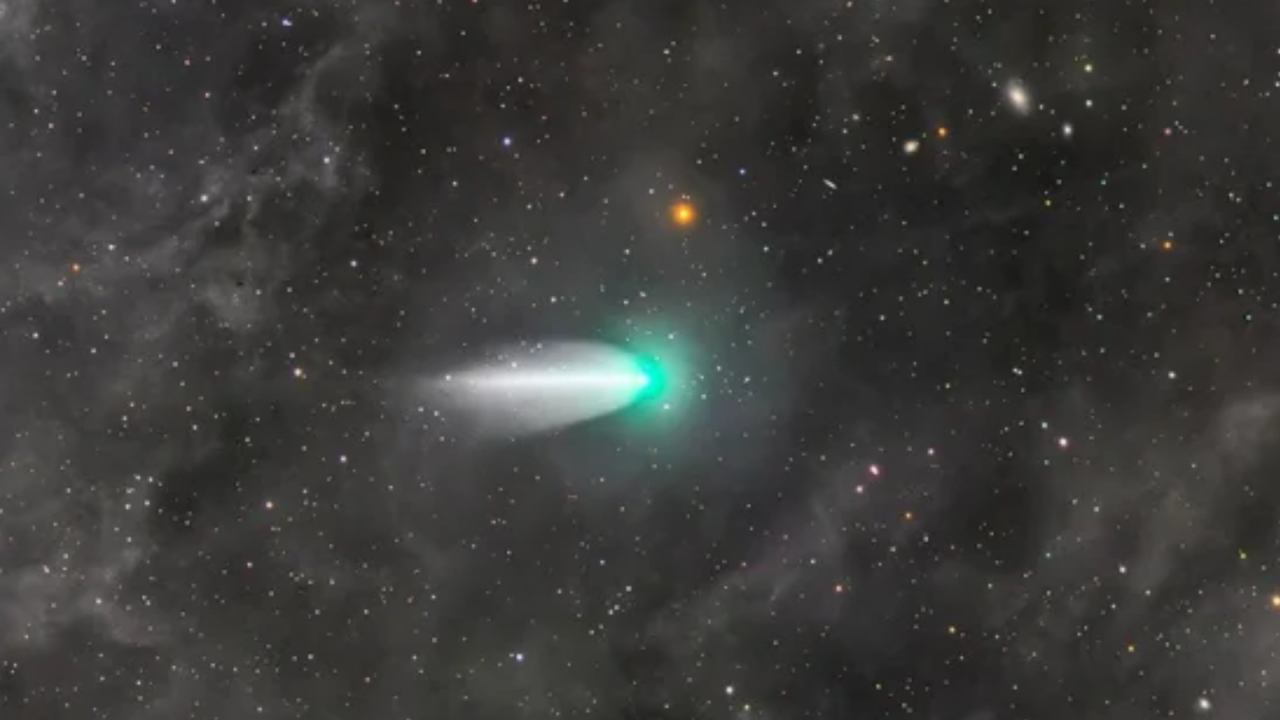
Comet 220P/McNaught, a periodic Jupiter-family comet discovered in 2004 by Australian astronomer Robert McNaught, experienced two dramatic outbursts this summer. These events were triggered by solar heating, which caused subsurface ice to rapidly sublimates into gas. The resulting pressure ripped apart localized sections of the comet’s crust, ejecting tens of billions of pounds of dust into space and causing the object to brighten by thousands of times.
The first outburst began on June 14 as the comet approached perihelion, its closest point to the sun at 1.5 astronomical units. In less than 14 hours, the comet’s magnitude improved from +17.39 to +11.05, making it visible through small amateur telescopes. By June 2, it had brightened further to magnitude +8.23, briefly becoming visible in binoculars from dark viewing sites. After fading back to magnitude +12 near perihelion, a second outburst occurred at the end of July, brightening the comet from magnitude +14 to +6.1 by early August.
Researchers explain that the sudden brightness increase was due to the expansion of dust particles, just millionths of a meter wide, moving outward from the nucleus at approximately 1,280 feet per second. This dust scattered sunlight, significantly increasing the luminosity of the comet’s coma. Josep M. Trigo-Rodríguez of the Institut de Ciències de l’Espai in Spain noted that the comet detached parts of its crust, creating a dust-rich envelope that boosted its brightness by 250 times within half a day.
The study of such outbursts is critical for understanding Jupiter-family comets, which originate from the Kuiper Belt and Scattered Disk before being captured into short-period orbits by Jupiter. Trigo-Rodríguez emphasized that these observations provide insights into the physical fragility of comets, which is relevant for planetary defense strategies. “Some comets seem determined to demonstrate that they are fragile enough and perhaps give us the chance to invoke disruptive approaches that might be substantially different from the ones already tested or proposed for asteroids,” he stated.
Since passing its closest approach to Earth on October 12 at a distance of 1.04 astronomical units, the comet is currently fading at magnitude +13. It will return to the inner solar system in late 2031. The detailed findings of this observation were published in the Monthly Notices of the Royal Astronomical Society on November 3.



Wait, it faded back to magnitude +13? That seems too faint for my backyard telescope. Did I miss the window?
The mention of planetary defense strategies is crucial here. Understanding cometary fragility really changes how we might approach deflection missions.
I actually caught the second outburst with my binoculars. The sudden jump in brightness was genuinely shocking to witness firsthand.